
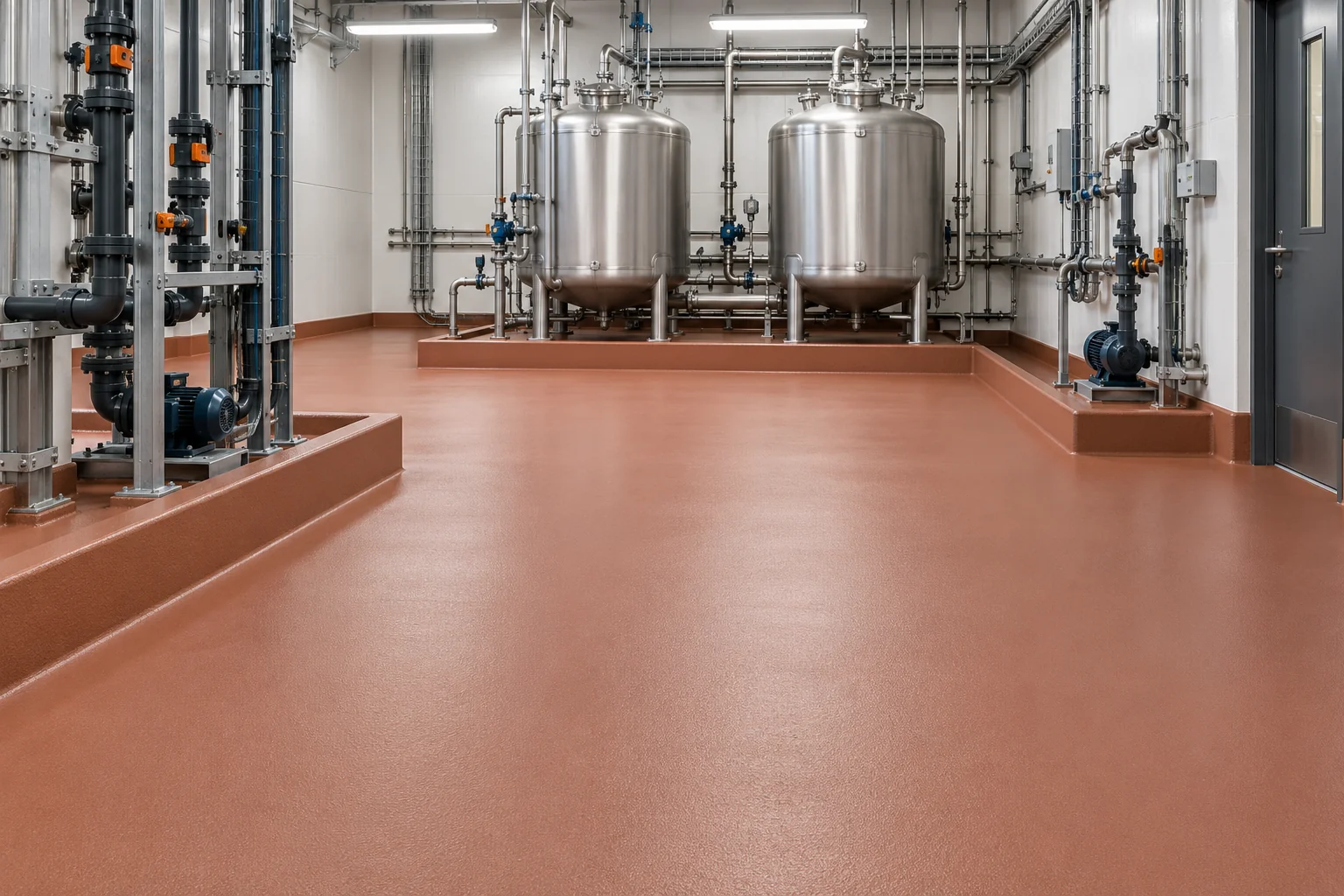
Chemical exposure • a specification-led approach
Chemical resistant flooring and epoxy lining systems.
Build the brief around the liquid, concentration, temperature and contact time. ALKA can then assess an appropriate floor or lining system for the exposure.
ALKA COATINGS · Technical guidance. Project-specific selection.
Understand the application
“Chemical resistant” needs a defined exposure.
A floor that handles promptly cleaned splashes may not suit continuous immersion in the same liquid. Mixtures, process temperature, cleaning chemicals and abrasion can change performance. Provide a chemical schedule so the system can be reviewed against the actual service conditions.
01
Process and handling areas
Map transfer points, filling lines and frequent spill locations. Include dwell time before cleanup and whether mechanical traffic acts on a contaminated surface.
02
Bunds and containment
Treat walls, upstands, joints, drains and penetrations as part of the lining design. Required containment capacity and structural movement need their own assessment.
03
Wastewater and aggressive exposure
Describe liquid composition, solids, concentration range and temperature. Review the lining for the specific continuous or intermittent exposure.
Compare the pathways
Choose the system around the service conditions.
| Application / requirement | ALKA pathway to review | Confirm before specification |
|---|---|---|
| Incidental, promptly cleaned spills | Assess a suitable ALKA epoxy floor | Confirm each chemical and the permitted contact conditions. |
| Aggressive chemical / wastewater lining | ALKA918 for technical review | Review AlkaTankline100 or Alka-Acid98 against the chemical schedule. |
| Wet heat plus chemicals and cleaning | Assess ALKA904 / ALKA905 | Thermal and traction requirements must be considered alongside chemistry. |
Selection guide only. Current product data, substrate assessment and the approved project specification determine suitability and the final build.
What goes into the floor
The ALKA system, layer by layer.
ALKA918
Novolac wastewater lining
500–1500+ µm
A lining pathway for approved aggressive chemical and wastewater exposures. Review each liquid and service condition before selection.
ALKA918 · surface to substrate
- LAYER 1AlkaTankline100 OR Alka-Acid98 lining, as specified
- LAYER 2ALKA105 primer for the concrete build
- LAYER 3Prepared concrete substrate
ALKA902
Standard epoxy floor
0.5–1.5 mm
An economical epoxy pathway for general industrial use where a thinner build suits the service conditions.
ALKA902 · surface to substrate
- LAYER 1ALKA110 finish coat
- LAYER 2ALKA110 epoxy body
- LAYER 3ALKA100 primer
- LAYER 4Prepared concrete
Listed builds reflect ALKA’s published system pages. Alternatives shown within a layer require a specified selection; they are not automatically interchangeable.
Alka 111 · Novolac epoxy · Chemical resistance
Check the chemical. Check the concentration.
The table below reproduces the chemical names, concentrations, resistance ratings and comments published in the Alka 111 Technical Data Sheet. These ratings are specific to Alka 111; they are not a resistance chart for every ALKA flooring or lining system.
Source: Alka 111 TDS · Version 3.1 · Updated 8 June 2026 · Table: page 3; rating notes: page 4.
Indicates minimal to no damage or degradation when exposed to the chemical.
Some resistance but may degrade over time with continuous exposure or higher concentrations.
Significant degradation or damage occurs with exposure.
No resistance rating is supplied in the table for this entry. Do not treat it as confirmation of suitability.
On a small screen, swipe the table sideways to see all three columns. A dash means the TDS leaves that comment blank.
| Chemical | Resistance | Comments from the TDS |
|---|---|---|
| Acids | ||
| Hydrochloric Acid (10%) | Commonly used in industrial applications. | |
| Hydrochloric Acid (20%) | Commonly used in industrial applications. | |
| Hydrochloric Acid (36%) | Commonly used in industrial applications. | |
| Sulfuric Acid (30%) | High concentration sulfuric acid is resisted effectively. | |
| Sulfuric Acid (50%) | High concentration sulfuric acid is resisted effectively. | |
| Sulfuric Acid (70%) | High concentration sulfuric acid is resisted effectively. | |
| Nitric Acid (up to 30%) | Resistance diminishes at higher concentrations. | |
| Acetic Acid (up to 5%) | Resistant to weak organic acids. | |
| Acetic Acid (up to 10%) | — | |
| Phosphoric Acid (up to 85%) | Handles high concentrations well. | |
| Lactic Acid (up to 10%) | — | |
| Alkalis | ||
| Sodium Hydroxide (up to 30%) | Common industrial alkali, no significant degradation. | |
| Potassium Hydroxide (up to 50%) | High alkali resistance. | |
| Ammonium Hydroxide (up to 10%) | Resistant to weak bases. | |
| Petroleum Products | ||
| Gasoline | Highly resistant to hydrocarbon-based fuels. | |
| Diesel Fuel | No significant impact. | |
| Jet Fuel | Well-suited for aerospace applications. | |
| Motor Oil | Can withstand prolonged exposure to motor oils. | |
| Salts and Brines | ||
| Sodium Chloride (saltwater) | Good resistance to salt and brine solutions, suitable for marine use. | |
| Calcium Chloride | Suitable for environments exposed to de-icing salts. | |
| Magnesium Chloride | No significant degradation. | |
| Other Chemicals | ||
| Hydrogen Peroxide (up to 30%) | Limited resistance to highly concentrated hydrogen peroxide. | |
| Formaldehyde | Moderate chemical resistance. | |
| Phenol | Handles phenolic compounds well, making it ideal for chemical industries. | |
The chart does not state a chemical-resistance test method, test temperature or exposure duration. It does not establish approval for hot service, continuous immersion, chemical mixtures or concentrations outside the listed entries. Confirm those conditions with ALKA before specifying the system.
The TDS advises consulting the manufacturer for specific chemicals or extreme conditions. Provide the chemical name, concentration, temperature, contact duration, cleaning method and whether exposure is splash, ponding or immersion.
Design and installation
A continuous lining depends on its weakest detail.
Substrate-specific preparation
Concrete and steel require different preparation and primer decisions. The ALKA918 concrete schematic on this page must not be used as a steel specification.
Joints and penetrations
Detail terminations, coving, drainage and movement joints. Continuity around pipework and equipment plinths deserves the same attention as the open floor.
Inspection and handover
Agree film-build checks and any specified continuity or holiday testing before installation. Define cure, exposure limits and a spill-response routine for the operator.
From enquiry to installation
Get the right people and information in place.
Start with a technical conversation and a clear project brief.
ALKA can help review the duty, identify a suitable system pathway and provide product information for your project. For installation, ask about an approved applicator referral for your location and scope; suitability and availability are confirmed for the project.
Practical questions
Before you choose the floor.
Is any resin resistant to every chemical?
No. Selection must be checked for the actual chemical, concentration, temperature and exposure duration. A generic chemical-resistance claim is insufficient.
Can a floor coating make a bund compliant?
A coating is one element of the containment design. Capacity, structure, joints, penetrations and any relevant project requirements must also be addressed.
How are chemical spills handled after installation?
Use the agreed spill-response and cleaning procedure. Inspect affected areas and arrange repairs where damage or loss of continuity is found; do not assume a coating allows indefinite contact.
Technical detail · products · practical answers
Specify the details that determine performance.
Build a chemical exposure register
List each substance by trade name and chemistry, concentration, normal and maximum temperature, contact duration and cleaning method. Include mixtures and process changes. Splash, repeated puddling and continuous immersion need separate assessment.
Treat the whole containment area
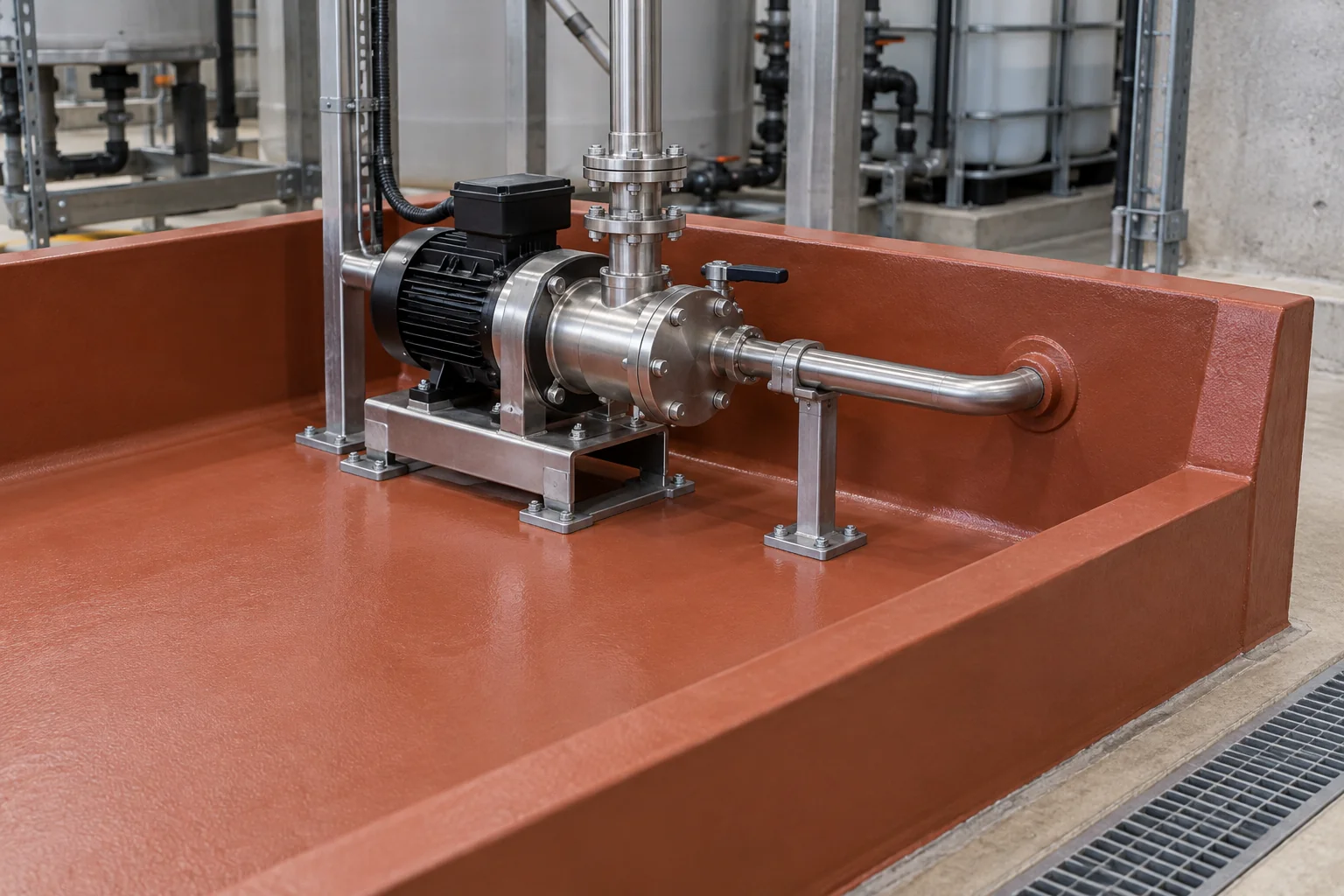
Detail bund floors, walls, coves, joints, drains and penetrations as a complete protection system. A resistant floor coating is ineffective if liquids can reach concrete through an untreated interface. Confirm the substrate and primer separately for concrete and steel.
Specify inspection and spill response
Agree thickness and continuity checks suitable for the selected lining, repair procedures and the cure period before chemical exposure. Keep a spill-removal and inspection routine. Discolouration, softening, blistering or loss of adhesion need prompt review.
ALKA products and technical data sheets
The products below relate to the pathways discussed on this page. Select one approved coating schedule for the project: alternative primers, binders and finishes are not a list of layers to combine automatically.
Use the current TDS and safety data for the exact product and supplied kit. Confirm substrate preparation, moisture limits, mixing, coverage, coat thickness, recoat intervals and full-service cure. Where a direct PDF is not listed, request the product-specific document from ALKA technical support before proceeding.
More answers for your project
Is chemical resistant the same as acid proof?
No. Resistance applies to particular chemicals under stated conditions. A product suitable for one acid or concentration may be unsuitable for another, for mixtures or for hot immersion. Request a written selection against your chemical register.
Can one system resist every chemical on site?
That should not be assumed. Separate zones may require different linings or containment arrangements. Supply cleaning agents as well as process liquids because the cleaning chemistry can be the more demanding exposure.
Will a topcoat make ordinary epoxy suitable for a bund?
Only if the complete build has been approved for that duty. A thin finish cannot automatically compensate for unsuitable underlying layers, pinholes or poorly detailed joints. Primer, lining thickness, interfaces and cure all matter.
Can a stained lining remain serviceable?
Sometimes staining is cosmetic, but appearance alone cannot confirm protection. Check for softening, swelling, blistering, cracking and adhesion loss, and obtain technical advice using the actual exposure history. Do not continue aggressive service solely because the surface looks intact.
When may chemical service start?
Use the full chemical-cure requirement of the approved lining at actual site conditions. Walking readiness and chemical readiness are different. Handover should record the release date and any restrictions on early cleaning or exposure.
Make the quote a complete scope
Ask the proposal to identify preparation and repairs, the selected ALKA products, coating stages, finish sample, joint and edge details, installation stages and the permitted return to service. Include cleaning instructions and the technical documents in the handover so future maintenance follows the installed system.
Let’s review your project
A floor selected for your space.
Share the operating conditions and the outcome you need. We’ll help you take the next step with a suitable ALKA system and installation pathway.
Tell us about your project
Leave your contact details and tell us about your chemical resistant flooring project. Include the location, approximate floor area, current surface condition and preferred timing. ALKA can help recommend a suitable system and discuss an applicator referral for your project.
Chemical resistant flooring — Sydney, Brisbane and Melbourne
Specify the actual chemical exposure before selecting an epoxy floor or lining. Provide chemical names, concentrations, temperature ranges, contact duration and whether the duty is splash, pooling or immersion.
Chemical resistant flooring in Sydney
For Sydney laboratories and production areas, identify concentrated chemical handling separately from general floor cleaning. Request a product-specific review and the required coating build.
Chemical resistant flooring in Brisbane
For Brisbane process sites, include chemical storage, rainwater entry and drainage in the exposure description. Bund walls, floor joints and penetrations form part of the containment detail.
Chemical resistant flooring in Melbourne
For Melbourne facilities, specify maintenance access and shutdown conditions alongside service chemistry. Ask about curing requirements before filling, washing or restarting the process.
ALKA 111 novolac epoxy · Wastewater lining system · Tank and containment system · Tank lining products
Request a project-specific ALKA system recommendation. Send your location, area, substrate photos and service conditions. Ask about product supply, current technical data and an applicator referral; availability and final suitability are confirmed for the project.