ALKA-9936
Chemical-Resistant Tank & Containment Lining System
High-performance chemical-resistant lining system designed for tanks, process vessels, bunds, pits and containment structures exposed to aggressive chemical service.
Available Colours
Specialist product colours
This system uses specialist protective or lining products. Colour availability depends on the specified exposed coating. Check the product pages below and confirm the required colour with ALKA; decorative flake blends do not apply to glass-flake barrier linings.
Screen and printed colours are approximate. Confirm your final selection with a physical sample. Lighting, texture, application and the selected system can affect the finished appearance.
Specialist Chemical Protection for Tanks, Vessels & Containment Areas
ALKA-9936 is a specialist protective lining system developed for steel and concrete assets exposed to chemical immersion, chemical splash, process liquids and secondary-containment service.
The system is based on ALKA Tanklin 100 and/or ALKA Tanklin Chem, selected according to the actual chemical environment, including chemical type, concentration, temperature, exposure duration and operating conditions.
Unlike a general-purpose epoxy coating, ALKA-9936 is not specified simply by substrate and film thickness. The correct lining must be selected according to the exact chemical service.
This makes ALKA-9936 particularly suitable for industrial assets where coating failure could result in substrate attack, contamination, leakage, shutdown or expensive remedial work.
PROTECTION STRATEGY
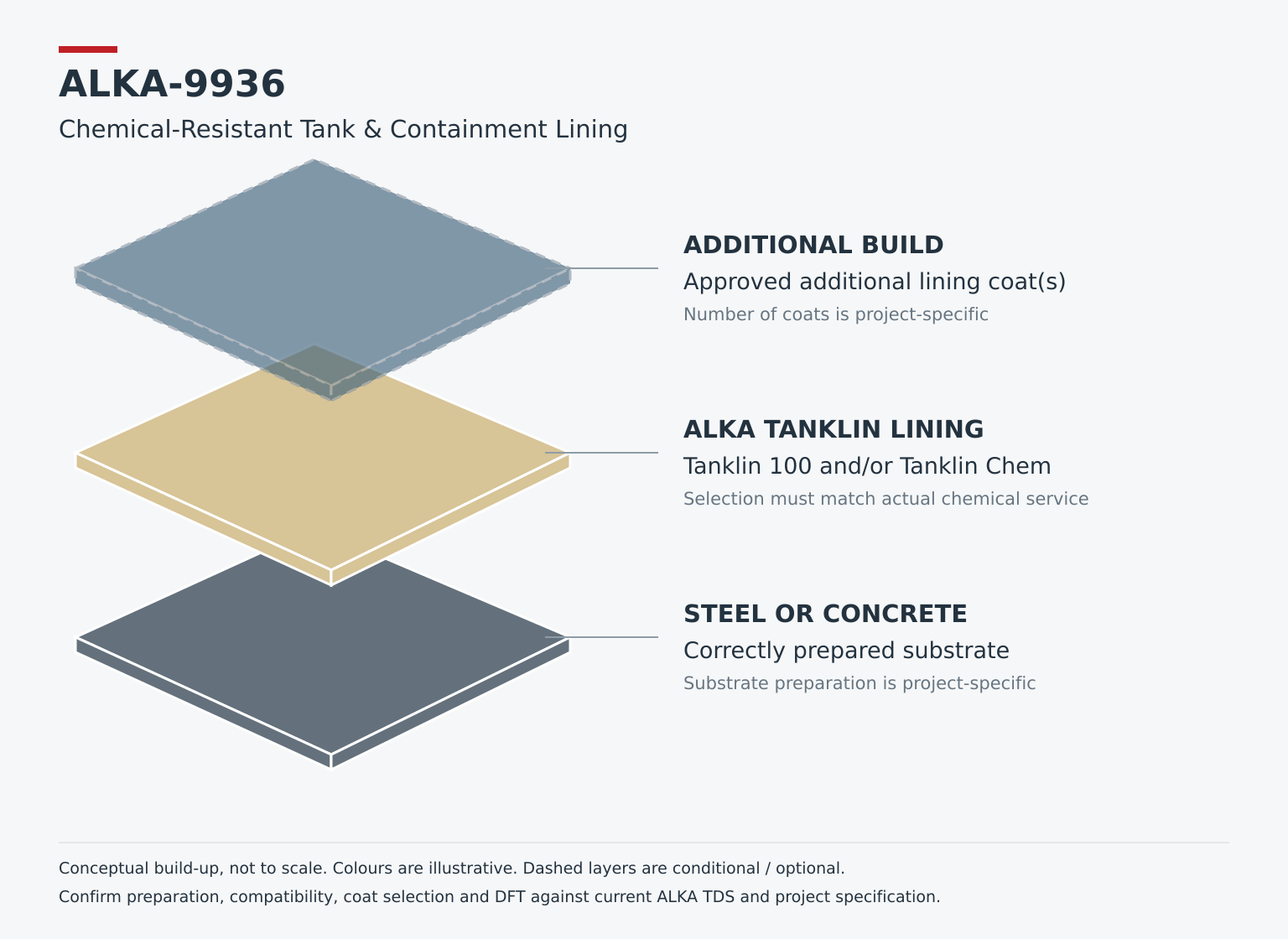
ALKA-9936 uses a:
Prepared Steel or Concrete → Chemical-Resistant Tanklin Lining → Additional Approved Build Where Required
strategy.
The lining forms a continuous protective barrier between the substrate and the chemical or process environment.
The system selection should consider:
- Chemical identity
- Chemical concentration
- Operating temperature
- Continuous or intermittent exposure
- Immersion or splash conditions
- Cleaning chemicals
- Process cycling
- Substrate type
- Required lining thickness
- Cure requirements before service
The system may use ALKA Tanklin 100, ALKA Tanklin Chem, or a project-approved combination where supported by the service requirements.
KEY PERFORMANCE BENEFITS
- Specialist chemical-resistant lining system
- Designed for aggressive industrial chemical service
- Suitable for steel tanks where approved
- Suitable for process vessels
- Suitable for concrete and steel bunds
- Suitable for secondary containment structures
- Suitable for process pits and sumps
- High-build protective lining construction
- Designed to isolate substrates from corrosive process media
- Suitable for immersion service where specifically approved
- Suitable for chemical splash and spill exposure where compatible
- Suitable for industrial wastewater and treatment areas where the chemical exposure has been assessed
- Product selection based on actual service conditions
- Can be engineered for project-specific total DFT
- Suitable for high-value containment assets
- Reduces direct chemical attack on concrete or steel substrates
- Appropriate for assets where lining continuity is critical
- Suitable for new construction and major refurbishment
- Can form part of a controlled chemical-containment specification
SYSTEM BUILD-UP
SUBSTRATE — Prepared Carbon Steel or Concrete
ALKA-9936 may be specified over carbon steel or appropriately prepared concrete, but preparation requirements differ significantly between these substrates.
The substrate condition must therefore be identified before the final lining specification is issued.
STEEL SUBSTRATE
Steel used for chemical lining must be prepared to a standard appropriate for critical protective lining service.
The surface must be free from:
- Rust
- Mill scale
- Oil and grease
- Soluble salts
- Process contamination
- Existing failed coatings
- Dust and abrasive residues
- Moisture
- Condensation
- Weld spatter
- Sharp edges
- Burrs
- Surface defects
Welds and fabricated details should be properly finished before coating because lining defects around welds, corners and edges can become critical failure points under immersion or chemical exposure.
CONCRETE SUBSTRATE
Concrete must be:
- Structurally sound
- Clean
- Free from laitance
- Free from curing compounds
- Free from oils and process contamination
- Free from weak surface material
- Mechanically prepared
- Suitable for the intended lining system
The concrete condition must also be assessed for:
- Cracks
- Honeycombing
- Blowholes
- Pinholes
- Surface voids
- Moisture
- Negative-side water pressure
- Construction joints
- Penetrations
- Wall/floor junctions
Defects should be repaired with compatible materials before lining application.
LINING — ALKA Tanklin 100
Function: Chemical-Resistant Protective Lining
ALKA Tanklin 100 is selected where its resistance profile is appropriate to the intended process liquid or chemical environment.
It forms a continuous high-build barrier between the substrate and the contained material.
Product: ALKA Tanklin 100
Position: Main protective lining
Primary Function: Chemical-resistant barrier protection
Nominal DFT: Project-specific and current ALKA TDS
ALTERNATIVE / SPECIALIST LINING — ALKA Tanklin Chem
Function: Specialist Chemical-Resistant Lining
ALKA Tanklin Chem is selected where the actual chemical service requires the resistance profile provided by this system.
Selection should be based on specific project data rather than general terms such as “acid resistant” or “chemical resistant.”
Product: ALKA Tanklin Chem
Position: Main or project-selected chemical-resistant lining
Primary Function: Specialist resistance to approved chemical service
Nominal DFT: Project-specific and current ALKA TDS
OPTIONAL MULTI-COAT BUILD
Depending on the project specification, the chemical-resistant lining may be applied in multiple coats to achieve:
- Required total DFT
- Better continuity
- Coverage over complex surfaces
- Improved inspection control
- Additional barrier thickness
- Project-specific service requirements
The number of coats must be established before application.
Nominal Total System DFT: Project-Specific
There is no single universal DFT for ALKA-9936.
The final lining thickness should be selected according to:
- Chemical service
- Concentration
- Temperature
- Substrate
- Immersion depth
- Exposure duration
- Process cycling
- Required design life
- Number of coats
- Inspection requirements
Final DFT must be confirmed against the applicable ALKA technical data and project-specific chemical-resistance review.
SUITABLE SUBSTRATES
ALKA-9936 can be considered for:
Prepared Carbon Steel
Including:
- Chemical storage tanks
- Process vessels
- Steel sumps
- Steel containment structures
- Process equipment
- Chemical treatment tanks
Appropriately Prepared Concrete
Including:
- Chemical bunds
- Process pits
- Concrete sumps
- Secondary containment
- Treatment structures
- Chemical storage areas
- Concrete tanks where approved
Substrate-specific preparation and lining selection are essential.
SERVICE & EXPOSURE ENVIRONMENT
ALKA-9936 is intended for chemical and containment service.
Typical exposure categories include:
- Continuous chemical immersion
- Intermittent immersion
- Chemical splash
- Chemical spills
- Secondary containment
- Process-liquid exposure
- Aggressive cleaning chemicals
- Industrial wastewater chemicals
- Process dosing areas
- Corrosive liquid storage
- Chemical transfer areas
- Chemical treatment facilities
The exact chemical compatibility must always be confirmed before final specification.
TYPICAL APPLICATIONS
Chemical Storage Tank Internals
Internal steel surfaces of tanks storing chemicals specifically approved for the selected ALKA Tanklin system.
This can include acids, alkalis, salts, process solutions or other industrial liquids, but only where the exact chemical service has been reviewed and confirmed.
Process Vessel Linings
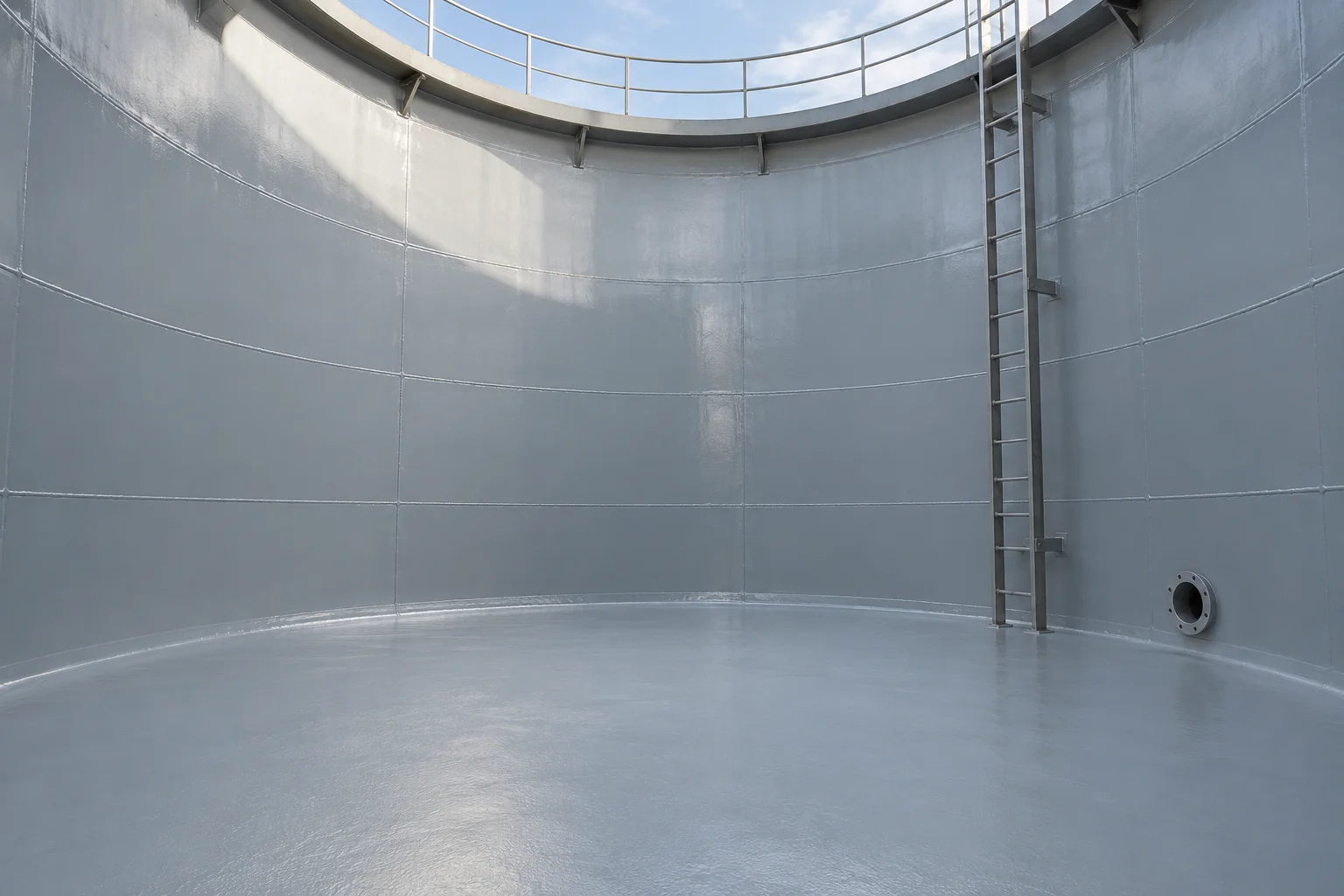
Internal surfaces of steel process vessels exposed to aggressive process media.
The lining selection should reflect actual operating temperature, chemical composition and expected exposure cycle.
Chemical Bunds
Concrete or steel bunds surrounding storage tanks, drums or process equipment.
ALKA-9936 can provide secondary-containment protection where chemical spills or leakage could otherwise attack the substrate.
Secondary Containment Areas
Containment floors, walls and curbs surrounding chemical storage or processing equipment.
These areas may be subject to intermittent spills rather than continuous immersion, but the lining must still be compatible with the chemicals involved.
Chemical Process Pits
Concrete or steel pits exposed to process liquids, washdown chemicals or chemical drainage.
Industrial Sumps
Sumps receiving compatible chemical liquids, process water or contaminated washdown.
Chemical Dosing Areas
Areas around dosing pumps, chemical injection equipment, storage vessels and treatment systems where splash or spill exposure is possible.
Water & Wastewater Treatment Facilities
Selected areas exposed to treatment chemicals such as dosing solutions, cleaning agents or aggressive process liquids.
The wastewater environment itself and any H₂S or acid-generation exposure must be reviewed separately.
Battery & Acid Handling Areas
Containment structures, floors, pits or bunds where compatible acidic service has been specifically reviewed.
Chemical Loading & Unloading Areas
Containment surfaces around tanker unloading points, transfer pumps and chemical handling equipment.
Industrial Process Rooms
Areas around vessels, tanks and process equipment where chemical splash, spill or washdown exposure is expected.
Acid / Alkali Containment
Steel or concrete assets exposed to acids or alkalis within the approved resistance range of the selected lining.
The actual chemical concentration and temperature must be known before specification.
SURFACE PREPARATION
Chemical lining service requires a higher level of preparation control than a normal atmospheric coating.
Any defect capable of allowing chemical penetration can compromise lining performance.
STEEL PREPARATION
Steel should be prepared to the lining standard required by the project.
Particular attention should be given to:
- Welds
- Corners
- Edges
- Bolts
- Crevices
- Nozzles
- Penetrations
- Flanges
- Internal attachments
Sharp edges should be rounded or otherwise treated as required.
Welds should be smooth enough to allow continuous coating coverage.
CONCRETE PREPARATION
Concrete preparation should remove weak and contaminated material and provide a clean, sound profile.
Repairs may be required for:
- Cracks
- Voids
- Honeycombing
- Blowholes
- Pinholes
- Damaged corners
- Construction defects
Where the lining must contain liquid, detailing around penetrations, joints and terminations is especially important.
MOISTURE ASSESSMENT
Concrete moisture must be assessed before lining.
Excessive moisture or vapour pressure can cause:
- Blistering
- Loss of adhesion
- Osmotic defects
- Local delamination
Where moisture risk exists, the complete system design must address it before the chemical lining is applied.
APPLICATION CONSIDERATIONS
Application should follow the current ALKA Tanklin technical data.
Critical controls include:
- Substrate temperature
- Ambient temperature
- Relative humidity
- Dew point
- Surface cleanliness
- Surface dryness
- Mixing ratio
- Mechanical mixing
- Pot life
- Induction requirements where applicable
- Wet-film thickness
- Dry-film thickness
- Application method
- Recoat interval
- Cure conditions
- Ventilation
- Maximum and minimum film build
- Cure time before chemical exposure
The lining must not be placed into chemical service before the required cure has been achieved.
FILM CONTINUITY
A chemical lining must form a continuous barrier.
Potential defects include:
- Pinholes
- Holidays
- Thin areas
- Voids
- Craters
- Missed corners
- Incomplete weld coverage
- Poor penetration around details
These defects can allow aggressive chemicals to contact the substrate even when the average coating thickness appears acceptable.
HOLIDAY TESTING
For critical containment or immersion service, project specifications may require holiday testing.
Holiday testing helps identify discontinuities in the cured lining.
Where specified, the test method must be suitable for:
- Substrate
- Total coating thickness
- Lining type
- Project standard
Any identified defects should be repaired and retested before service.
INSPECTION & QUALITY CONTROL
Chemical lining projects should include documented quality control.
Depending on the project, this may include:
- Substrate condition inspection
- Surface preparation verification
- Surface-profile measurement
- Environmental-condition recording
- Concrete moisture testing
- Weld inspection
- Primer/lining inspection
- Wet-film thickness checks
- Dry-film thickness measurements
- Recoat-window verification
- Cure-time verification
- Holiday testing
- Adhesion testing where specified
- Final continuity inspection
- Batch-number recording
- Application-condition records
- Final release-to-service inspection
CHEMICAL RESISTANCE SELECTION
The most important specification requirement for ALKA-9936 is accurate chemical-service information.
A statement such as:
“Chemical resistant coating required”
is not sufficient.
The following information should be supplied:
- Chemical name
- Chemical concentration
- Mixture composition
- Operating temperature
- Maximum upset temperature
- Continuous or intermittent exposure
- Immersion duration
- Cleaning regime
- Frequency of spills
- Expected pH
- Process cycling
- Substrate
- Required service life
Without this information, chemical resistance cannot be specified responsibly.
WHY SPECIFY ALKA-9936?
ALKA-9936 should be selected when the coating system must function as a chemical containment barrier, not simply an atmospheric corrosion coating.
Its protective logic is:
Prepared Steel / Concrete → Selected ALKA Tanklin Chemical-Resistant Lining → Required Total DFT → Inspection & Continuity Verification
The system is therefore appropriate where:
- Chemicals may directly contact the coating
- Conventional epoxy coatings may not provide sufficient resistance
- Secondary containment is required
- Tank internals require specialist lining
- Process equipment requires chemical protection
- Coating failure could lead to substrate attack or leakage
WHEN TO CHOOSE ALKA-9936
ALKA-9936 should be considered when:
- The service includes chemical immersion
- A tank internal requires a chemical-resistant lining
- A bund must contain aggressive liquids
- A process vessel contains corrosive media
- A process pit or sump receives chemicals
- Exact chemical data is available
- Chemical resistance is more important than decorative finish
- A project-specific lining specification is required
- Lining continuity must be inspected and verified
ALKA-9936 VS ALKA-9935
ALKA-9935 is primarily a glass-flake reinforced high-barrier lining system.
ALKA-9936 is a chemical-resistant containment lining system selected according to actual chemical service.
Therefore:
Severe barrier requirement without a specific aggressive chemical driver → ALKA-9935
Defined chemical immersion or containment requirement → ALKA-9936
ALKA-9936 VS ALKA-918
ALKA-918 is positioned specifically around wastewater, H₂S, sulfuric-acid formation and wastewater structural lining.
ALKA-9936 is broader and is selected for defined chemical tank, vessel and containment service.
Where wastewater corrosion is the dominant exposure, ALKA-918 may provide a more specific system concept.
Where the project revolves around a known process chemical, ALKA-9936 is the more direct category.
LIMITATIONS
ALKA-9936 must not be specified by generic assumptions.
Key limitations include:
- Chemical compatibility must be confirmed
- Concentration must be known
- Temperature must be known
- Mixtures may behave differently from individual chemicals
- Continuous immersion and splash exposure are not equivalent
- Cure before service is critical
- Concrete moisture can affect lining performance
- Poor substrate preparation can cause premature failure
- Structural cracks require appropriate repair
- Coating does not replace structural containment design
- Unknown chemicals should not be assumed compatible
- Chemical resistance at ambient temperature does not automatically establish resistance at elevated temperature
- UV stability should not be assumed unless an appropriate finish is specified
- High film thickness does not compensate for pinholes or holidays
SPECIFICATION GUIDANCE
A complete ALKA-9936 specification should define:
Substrate → Chemical → Concentration → Temperature → Exposure Type → Surface Preparation → Repairs → Primer/Sealer Where Required → Tanklin Product Selection → Number of Coats → Individual DFT → Total DFT → Detail Coating → Recoat Windows → Cure Before Service → Holiday Testing → Inspection → Acceptance Criteria
For tank internals and containment systems, the specification should also define:
Weld Preparation → Nozzle Detailing → Penetrations → Corners → Joints → Terminations → Repair Procedure → Final Inspection → Service Release
SYSTEM POSITIONING
ALKA-9936 should be presented to engineers, asset owners, chemical processors and industrial contractors as:
A project-engineered chemical-resistant lining system for steel and concrete tanks, vessels, bunds and containment structures where the exact chemical service determines the coating selection.
Its core value proposition is:
Chemical-specific system selection + high-build containment protection + steel/concrete capability + continuity-focused lining design + project-specific DFT and inspection.
Application Examples
Applications are subject to project-specific approval of the substrate, lining, chemical service and operating temperature.

Process Vessel Linings

Chemical Bunds & Containment

Chemical Dosing Areas
Photographic visuals on this page are AI-generated application illustrations, not completed ALKA projects. Colours are illustrative. The system schematic is conceptual and not to scale; refer to current ALKA technical data and project specifications.