Warehouse epoxy flooring designed around your traffic.
Australian-manufactured ALKA resin flooring systems for warehouses, distribution centres and loading facilities—specified around forklift wheel loads, turning shear, abrasion, impact, slab condition, line marking and available shutdown.
Specify aisles, turns, docks and storage areas separately.
A straight forklift aisle, a tight turning intersection, a pedestrian pick face and a loading-dock threshold do not impose the same stress. The correct specification maps traffic type and frequency before selecting resin chemistry, thickness, texture and line marking.
Turning zones wear first
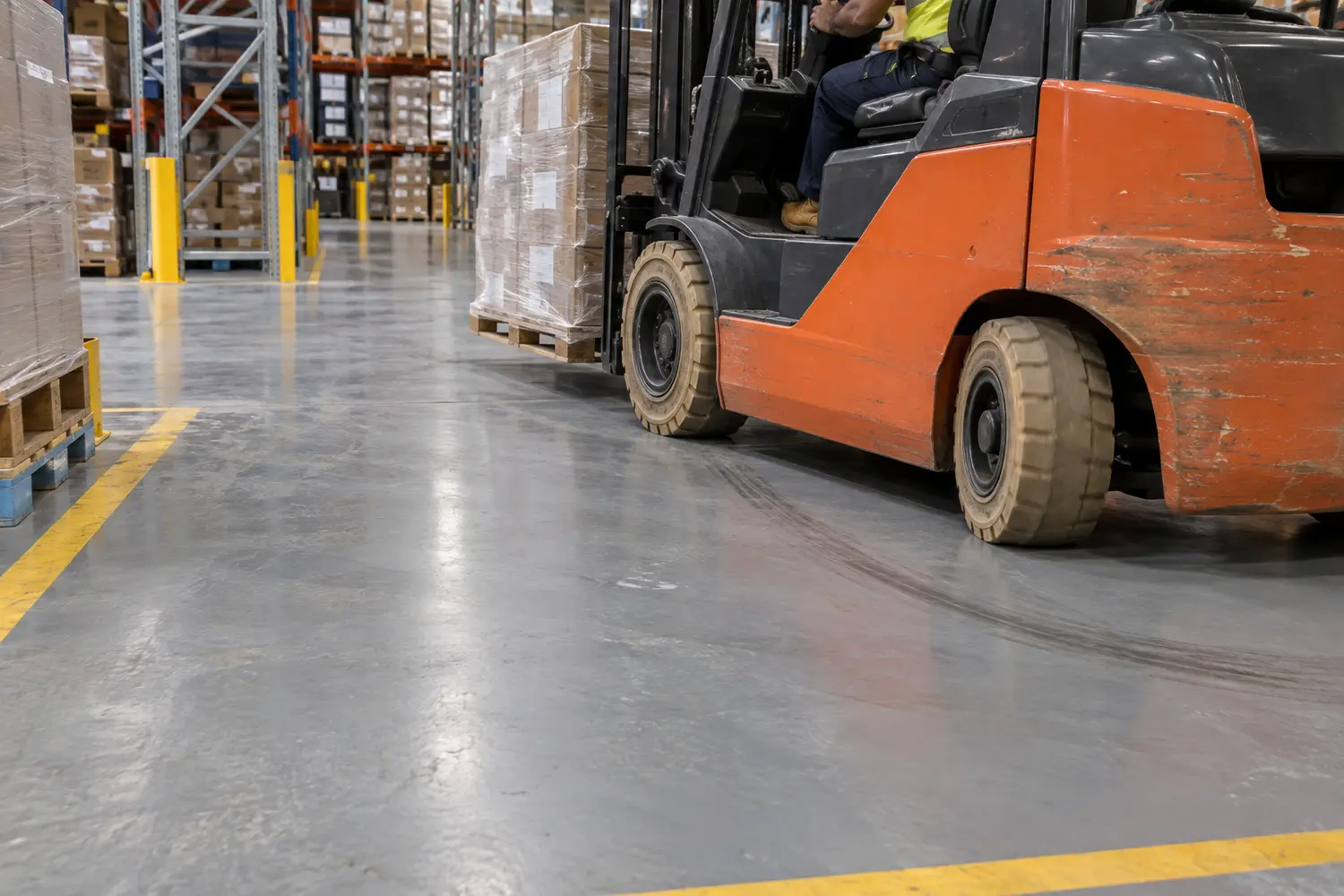
Hard wheels, braking and tight turns create concentrated shear. Wheel material, axle load, traffic frequency and turning geometry must be known—not guessed.
The coating follows the slab
Laitance, dusting concrete, cracks, joints, oil contamination, moisture and failed coatings must be assessed before any resin system is nominated.
Shutdown controls the chemistry
Installation sequence, temperature, cure, staged access and return-to-service timing can make a conventional epoxy or rapid-cure polyaspartic the better choice.
Design for wheels, loads and movement.
- Reach trucks and forklifts: wheel hardness, axle loading and tight-turn frequency.
- Pallet jacks and trolleys: small hard wheels can create high contact pressure.
- Racking: rack-foot loading and anchor details rely on sound concrete, not coating thickness.
- Impact: dropped pallets, tools and steel components require realistic repair planning.
- Joints: moving joints remain joints; rigid resin is not a structural movement solution.
The visible finish cannot compensate for weak or moving concrete. Substrate repair and joint strategy belong in the flooring specification.
Match the build to the operating condition.
| Zone or condition | Main risks | Specification response |
|---|---|---|
| Main forklift aisles | Abrasion, repeat wheel passes | High-build resin body, sound preparation and thickness selected for traffic intensity. |
| Intersections and turning bays | High shear from braking and turning | Upgrade the local build; avoid treating these zones as ordinary straight aisles. |
| Loading docks and open doors | Water tracking, grit, UV and temperature variation | Review texture, drainage, UV-stable finish and threshold detailing. |
| Battery charging / maintenance | Acids, electrolytes, oil or service fluids | Provide the chemical schedule and select a compatible chemical-resistant pathway. |
| Pedestrian pick faces | Slip risk, visibility and cleaning | Zone walkways, select practical texture and coordinate line marking. |
| Cold store interfaces | Condensation and thermal cycling | Review operating temperature, dew point, substrate and resin suitability separately. |
Three warehouse pathways—not one generic build.
These schematics use the published ALKA Flooring System structures. Final consumption, thickness, aggregate and recoat requirements must follow the current TDS and approved project specification.
Self-levelling epoxy, 2–4 mm
Standard epoxy, 0.5–1.5 mm
Polyaspartic, 1–2 mm
The relevant systems and where each one belongs.
ALKA-901 Premium Self-Levelling Epoxy System
Smooth, dense and seamless 2–4 mm epoxy flooring for demanding warehouses where forklift traffic, hygiene, cleanability and professional appearance are important.

ALKA-902 Standard Epoxy Floor System
A practical 0.5–1.5 mm system for storage, distribution and general industrial floors where the 2–4 mm self-levelling build of ALKA-901 is not required.
ALKA-908 Heavy-Duty Workshop Floor System
Also relevant to warehouse loading and material-handling areas exposed to forklifts, vehicles, oils and heavier mechanical wear.
ALKA-910 Rapid-Cure Polyaspartic Floor System
Fast-curing, UV-stable 1–2 mm pathway for operating warehouses where a shorter shutdown and faster return to service are key project constraints.
System choice is not based on price or colour alone. Forklift duty, slab condition, exposure, area staging and cure conditions determine the appropriate pathway.
Build visibility into the floor.
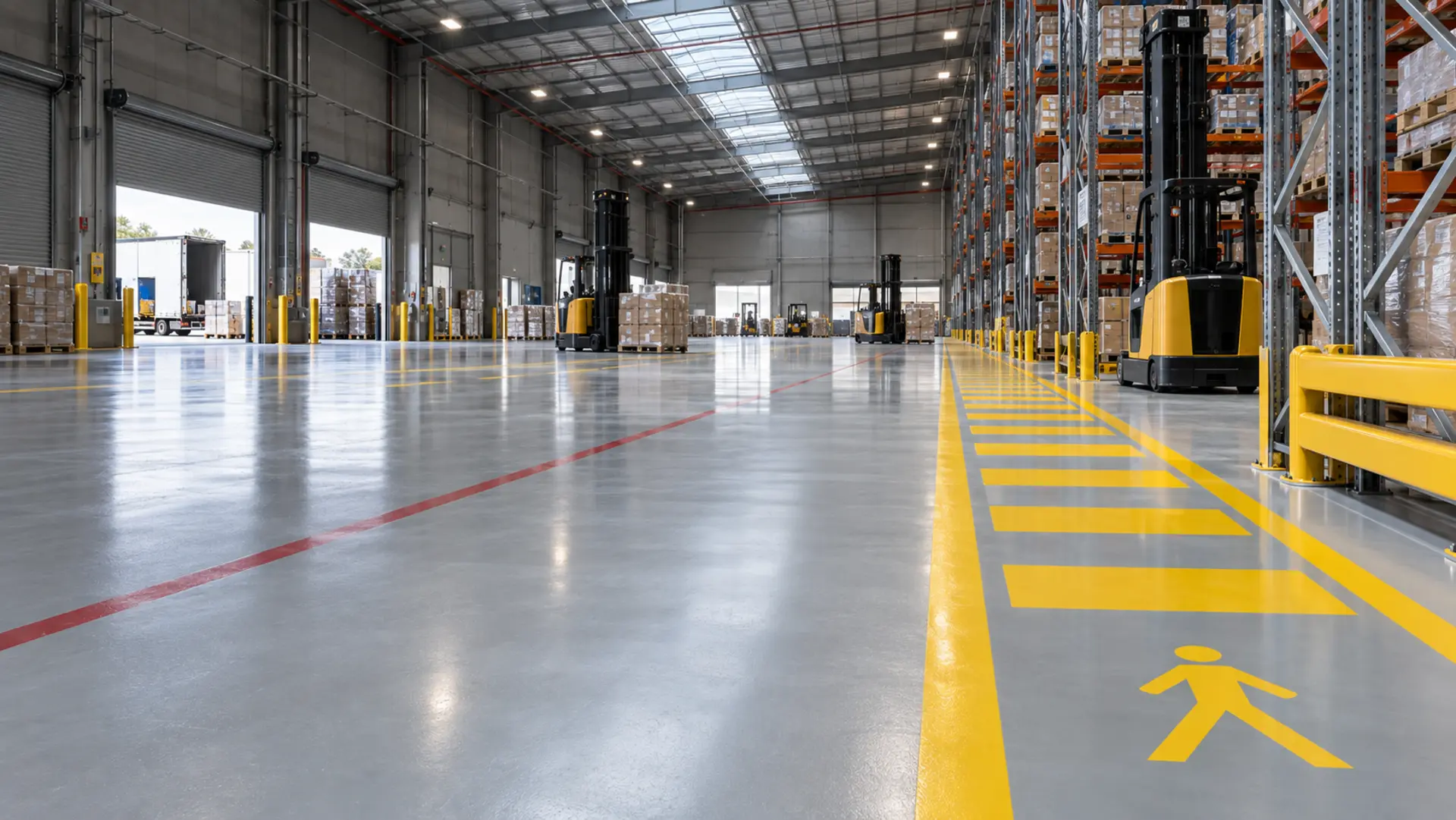
Pedestrian routes, forklift aisles, exclusion boxes, loading zones and fire-equipment clearances can be coordinated as part of the flooring works. Line marking still needs compatible products, suitable cure and maintenance planning.
- Use contrasting colours for vehicle and pedestrian separation.
- Increase slip texture where water or grit is tracked through dock doors.
- Keep the main traffic finish practical for sweeping and scrubber cleaning.
- Confirm final colour using physical samples rather than screen appearance.
A warehouse floor is a planned shutdown.
Map the duty
Traffic routes, loads, wheels, chemicals, wet areas and UV exposure.
Survey the slab
Strength, cracks, joints, old coatings, contamination and moisture.
Design the build
System, thickness, texture, colours and local upgrades by zone.
Stage the work
Access, preparation, temperature, cure and operational isolation.
Return to service
Verify cure, finish, line marking and maintenance requirements.
Send us the project conditions—not just the floor area.
Tell ALKA about the traffic, forklift types, slab condition, wet or chemical zones, finish requirements and available shutdown. As the manufacturer and technical system reference, we can review the project information and recommend the most suitable ALKA flooring system and build-up for the actual operating conditions.
Plans, photos and operating conditions
Send the floor area, concrete age and condition, existing coatings, forklift or trolley traffic, exposure, cleaning regime and programme.
ALKA reviews the complete duty
We can identify the most appropriate system pathway, thickness, texture, colour and local upgrades—subject to site assessment and the approved project specification.
Need the right applicator?
Where required, ALKA can introduce a suitable experienced contractor or selected applicator for the project type and location. The contractor remains responsible for site assessment, quotation and installation.
Clear answers before products are ordered.
Which ALKA system is best for forklift traffic?
ALKA-901 is the main high-build self-levelling pathway for demanding warehouses. ALKA-902 can suit general-duty storage and distribution areas, while ALKA-908 may be relevant to heavier loading or service zones. The answer depends on wheel type, axle load, traffic frequency, turning and slab condition.
Does a thicker floor always last longer?
Thickness matters, but preparation, concrete strength, adhesion, resin chemistry, cure and traffic severity matter as well. Extra thickness over weak or contaminated concrete does not correct the underlying problem.
Can the floor be slip resistant and still easy to clean?
Yes, if texture is selected by zone. Dock thresholds and wet entries may require greater texture than dry storage aisles. Increasing texture generally increases cleaning effort, so one aggressive finish should not automatically cover the whole building.
Can the warehouse remain operating?
Often the works can be staged, but traffic separation, dust control, preparation noise, cure conditions and safe access must be agreed in advance. ALKA-910 may be considered when rapid return to service is a major requirement.
Can an existing coating be overcoated?
Only after its type, adhesion and compatibility are assessed. Loose, contaminated, weak or incompatible coatings may require full removal.
How are cracks and joints handled?
Static cracks may be repaired after assessment. Moving joints need an appropriate joint detail and generally should not simply be bridged with a rigid coating.
Can we see colours and samples?
Yes. Visit the ALKA showroom at 87 Market Street, Smithfield to compare colours and surface textures, and take samples away for internal review.
Does ALKA install warehouse floors?
ALKA is the Australian manufacturer and technical system reference. Suitable projects may be connected with selected applicators; installation responsibility is confirmed for each project.
Technical detail · products · practical answers
Specify the details that determine performance.
Specify wheel contact, not only tonnes
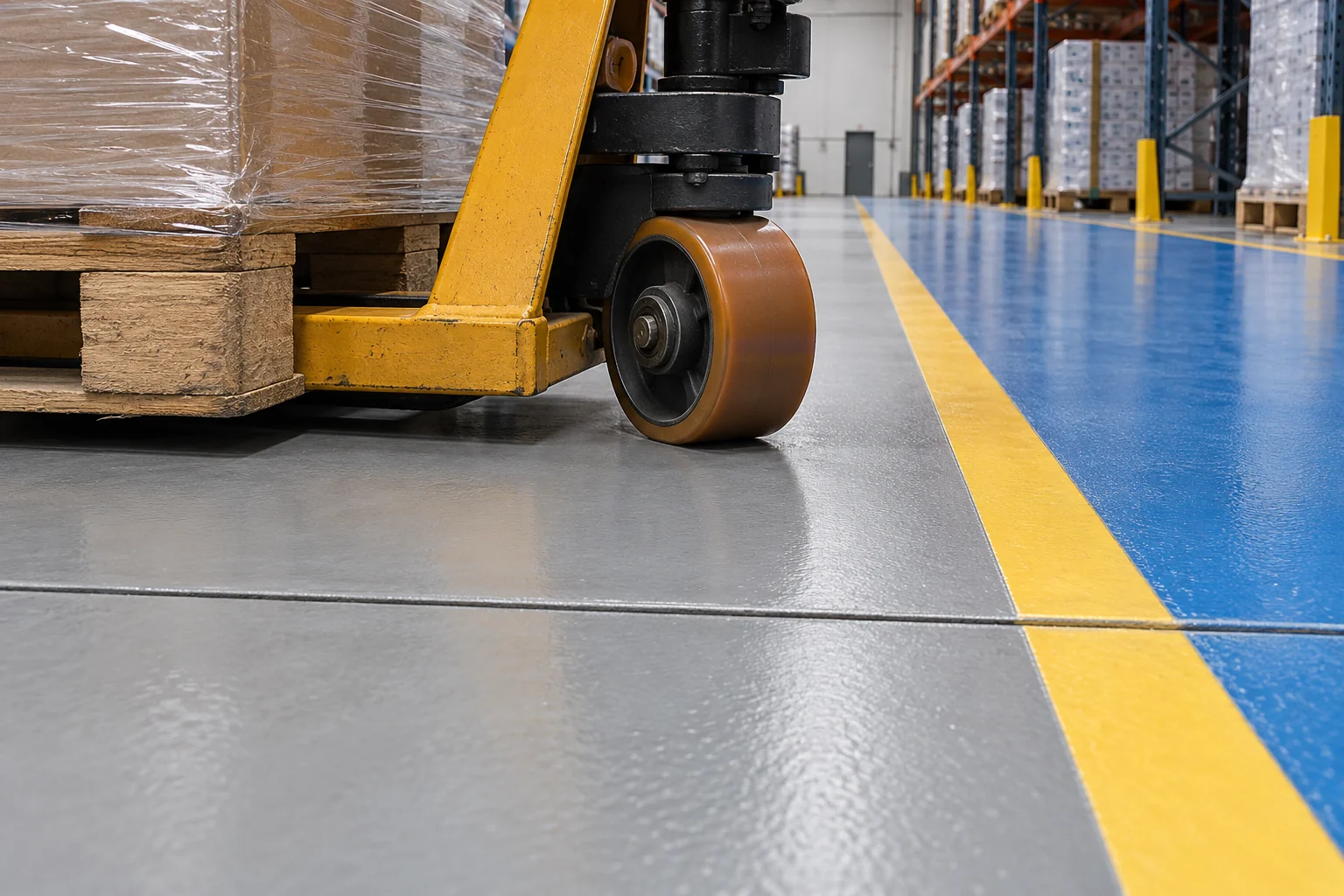
Small hard wheels and repeated turning can concentrate wear more severely than a larger pneumatic tyre. Provide forklift and pallet-jack types, loaded weights, wheel material and turning frequency. Review narrow-aisle and loading areas separately from static storage.
Repair joints and check levels
Broken joint edges cause impact under wheels and can accelerate local coating damage. Repair the slab and detail movement before coating. High-bay or very-narrow-aisle flatness requirements need their own assessment; a resin finish is not a substitute for a compliant slab profile.
Make zoning maintainable
Coordinate pedestrian routes, crossings, racking and emergency access with the site layout. Specify compatible line-marking products and recoat timing. Plan installation stages so traffic cannot cross uncured areas or carry preparation dust into clean zones.
ALKA products and technical data sheets
The products below relate to the pathways discussed on this page. Select one approved coating schedule for the project: alternative primers, binders and finishes are not a list of layers to combine automatically.
Use the current TDS and safety data for the exact product and supplied kit. Confirm substrate preparation, moisture limits, mixing, coverage, coat thickness, recoat intervals and full-service cure. Where a direct PDF is not listed, request the product-specific document from ALKA technical support before proceeding.
More answers for your project
Will a coating stop concrete dust?
A continuous, correctly bonded system can seal a sound concrete surface and make cleaning easier. If the slab is weak, friable or moisture-affected, those causes must be addressed first. Covering dusting concrete without preparation can simply move the failure to the coating interface.
Can forklift tyre marks be removed?
Some marks are surface deposits; others can involve staining or wear. Use the finish manufacturer’s cleaning method and a suitable pad, then rinse and recover residues. Aggressive scrubbing or solvents can damage sheen and should not be assumed acceptable.
Do rack feet need special treatment?
Racking loads and anchors are structural details. Coordinate their installation, protection, sealant interfaces and access with the coating work. The coating cannot increase the bearing capacity of a slab or repair an inadequately designed rack foundation.
How can we keep operating during installation?
Develop a staged traffic plan with the applicator, including unloading routes, dust separation, temporary barriers and cure release points. Reopening one zone early is only useful if it can be reached without crossing another zone that is still curing.
Make the quote a complete scope
Ask the proposal to identify preparation and repairs, the selected ALKA products, coating stages, finish sample, joint and edge details, installation stages and the permitted return to service. Include cleaning instructions and the technical documents in the handover so future maintenance follows the installed system.
Send the traffic map—not just the square metres.
Provide the warehouse plan, floor area, slab photos, forklift types, loads, operating hours, wet or chemical zones and available shutdown. ALKA can recommend the most suitable system pathway and, where required, connect you with an experienced contractor for the project.
Tell us about your project
Leave your contact details and tell us about your warehouse flooring project. Include the location, approximate floor area, current surface condition and preferred timing. ALKA can help recommend a suitable system and discuss an applicator referral for your project.
Warehouse epoxy flooring — Sydney, Brisbane and Melbourne
Specify warehouse floor coatings around forklift routes, turning zones, loading docks and slab condition. ALKA supplies system information to help owners and contractors compare a standard epoxy build, high-build self-levelling flooring and suitable rapid-return options.
Warehouse epoxy flooring in Sydney
For Sydney warehouses and distribution centres, send the traffic plan, forklift wheel type and photographs of joints or damaged concrete. Separate heavily used turning zones from lighter-duty storage areas in the coating schedule.
Warehouse epoxy flooring in Brisbane
For Brisbane warehouse projects, identify rain tracking at loading docks, moisture risk and exposure at open doors. Specify the finish texture and cleaning method for these areas separately from dry storage aisles.
Warehouse epoxy flooring in Melbourne
For Melbourne warehouse refurbishment, plan preparation and cure around loading operations and substrate temperature. Agree staged access, joint treatment and when forklifts may return to each completed area.
High-build epoxy system · Standard epoxy system · ALKA 110 epoxy · Industrial flooring options
Send your project location, area and photos for a system recommendation. Ask about product supply, current technical data and an applicator referral for your location. Installation availability and the final coating schedule are confirmed for each project.