ALKA-9939
Splash & Tidal Zone Protective Coating System
Heavy-duty high-build marine barrier system designed for steel structures exposed to severe splash, tidal, intermittent immersion and repeated wet/dry seawater cycling.
Available Colours
Specialist product colours
This system uses specialist protective or lining products. Colour availability depends on the specified exposed coating. Check the product pages below and confirm the required colour with ALKA; decorative flake blends do not apply to glass-flake barrier linings.
Screen and printed colours are approximate. Confirm your final selection with a physical sample. Lighting, texture, application and the selected system can affect the finished appearance.
Severe Marine Protection for Splash & Tidal Exposure
ALKA-9939 is a heavy-duty marine protective coating system developed specifically for steel structures exposed to direct seawater splash, tidal cycling, intermittent immersion and continuously wet marine conditions.
These exposure zones are among the most aggressive environments encountered by protective coating systems. Unlike normal marine atmospheric service, splash and tidal areas are subjected to repeated chloride loading, oxygen-rich seawater, wet/dry cycling and persistent moisture.
ALKA-9939 addresses these conditions through a substrate-specific primer followed by ALKA-414 Glass Flake Epoxy or an approved ALKA Ultra-High-Build Epoxy system, selected according to the project requirements.
The system is therefore designed around maximum barrier integrity, high film build and resistance to repeated seawater exposure, rather than appearance or decorative finish.
ALKA-9939 is intended for critical marine infrastructure where coating failure can lead to rapid corrosion, difficult access and expensive repair.
PROTECTION STRATEGY
ALKA-9939 uses a:
Prepared Marine Steel → Substrate-Specific Primer → Glass-Flake / Ultra-High-Build Epoxy Barrier
strategy.
The primer is selected to provide the correct interface between the prepared steel and the severe-duty marine barrier layer.
The main protective layer is then provided by either:
ALKA-414 Glass Flake Epoxy
or
Approved ALKA Ultra-High-Build Epoxy System
depending on the required total film build, geometry, exposure severity and project specification.
The system is designed to create a thick, continuous and highly protective barrier against:
- Direct seawater contact
- Chloride penetration
- Repeated wet/dry cycling
- Splash exposure
- Tidal immersion
- Persistent moisture
- Marine atmospheric contamination
KEY PERFORMANCE BENEFITS
- Designed specifically for marine splash and tidal zones
- Suitable for repeated direct seawater exposure
- Heavy-duty high-build barrier construction
- Glass-flake reinforced epoxy option
- Ultra-high-build epoxy option
- Suitable for intermittent immersion
- Suitable for severe wet/dry cycling
- Designed for high chloride exposure
- Suitable for critical marine infrastructure
- High protective film thickness
- Suitable for difficult-access marine assets
- Robust barrier against moisture and seawater penetration
- Project-specific primer selection
- Project-specific DFT selection
- Suitable for new construction and major marine refurbishment
- Suitable for wharves, jetties and piling structures
- Strong option where atmospheric marine coatings are insufficient
- Functional severe-service system where protection takes priority over appearance
SYSTEM BUILD-UP
SUBSTRATE — Prepared Marine Carbon Steel
ALKA-9939 is primarily intended for carbon steel exposed to severe marine wet-service conditions.
The substrate must be properly prepared before application.
Marine steel preparation should address:
- Heavy corrosion
- Rust scale
- Marine fouling
- Chloride contamination
- Soluble salts
- Existing failed coatings
- Oil and grease
- Moisture
- Weld contamination
- Sharp edges
- Surface defects
- Pitting
- Crevices
- Difficult-access areas
The blast-cleaning standard and surface profile must be appropriate to the selected primer and barrier coating.
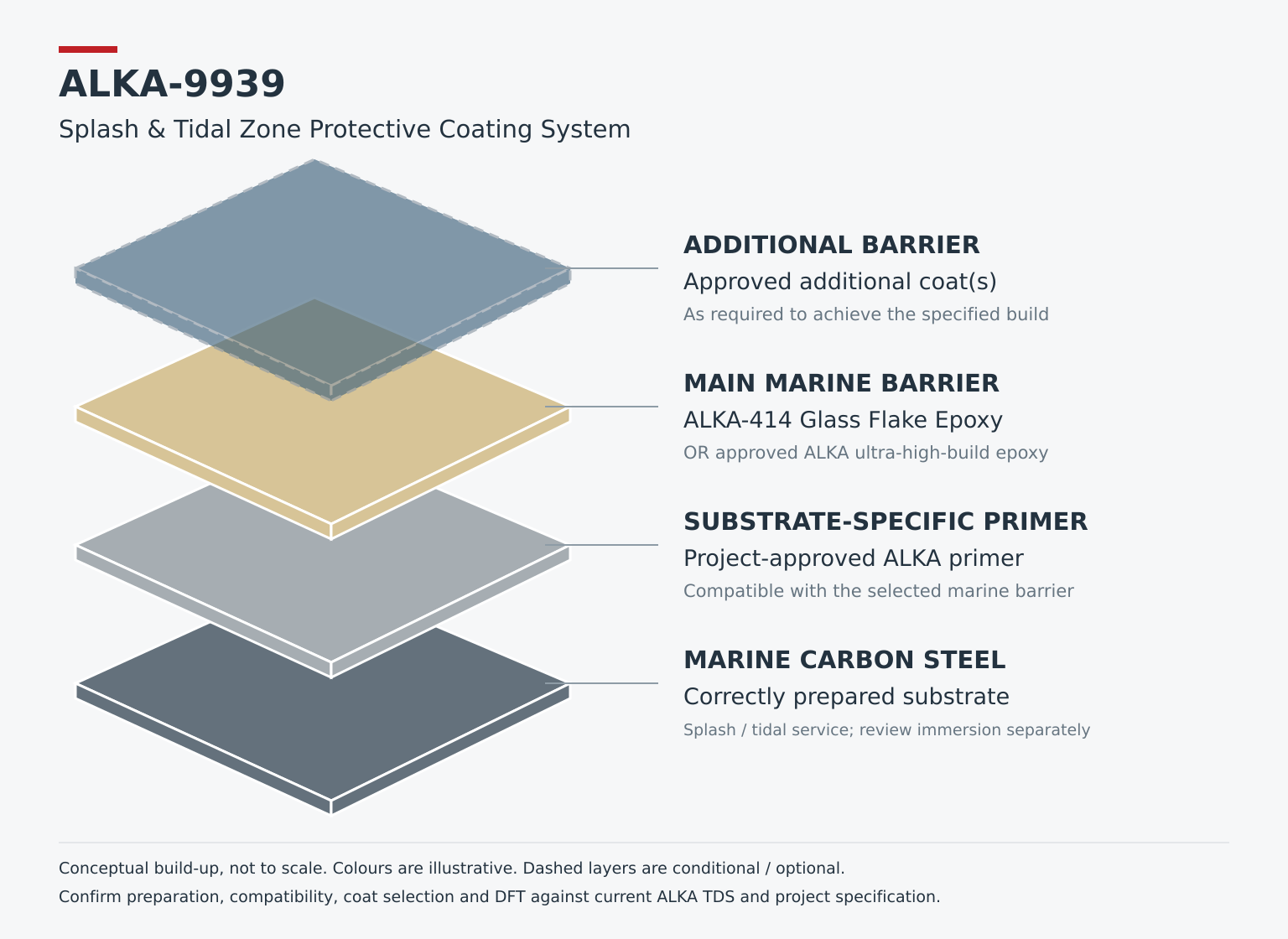
PRIMER — SUBSTRATE-SPECIFIC ALKA PRIMER
Function: Adhesion and Initial Corrosion Protection
The primer is selected according to:
- Steel condition
- Surface preparation
- Exposure zone
- Selected ALKA barrier system
- Required compatibility
- Project specification
The primer establishes adhesion and provides the foundation for the high-build marine barrier.
Product: Project-approved ALKA primer
Position: Directly over prepared marine steel
Primary Function: Adhesion and initial corrosion protection
Nominal DFT: Project-specific / current ALKA TDS
BARRIER OPTION 1 — ALKA-414 Glass Flake Epoxy
Function: Heavy-Duty Reinforced Marine Barrier
ALKA-414 forms a high-build, glass-flake reinforced epoxy barrier designed for severe wet-service conditions.
The glass-flake reinforcement increases the tortuous path through the coating film and supports improved barrier performance against direct marine exposure.
Product: ALKA-414 Glass Flake Epoxy
Position: Main marine barrier coat
Primary Function: High-build reinforced seawater barrier
Nominal DFT: To project specification and current ALKA TDS
BARRIER OPTION 2 — Approved ALKA Ultra-High-Build Epoxy System
Function: Ultra-High-Build Severe Marine Protection
Where the project requires greater total film build or a more substantial barrier than the standard glass-flake configuration, an approved ALKA ultra-high-build epoxy system may be specified.
This option is particularly relevant where:
- Exposure severity is extreme
- Steel geometry is complex
- Greater total barrier thickness is required
- The structure is difficult to access for future maintenance
- The project design life justifies a heavier build
Product: Approved ALKA Ultra-High-Build Epoxy
Position: Main severe-duty marine barrier
Primary Function: Very high-build seawater and chloride barrier
Nominal DFT: Project-specific
OPTIONAL ADDITIONAL BARRIER COATS
Additional ALKA-414 or approved barrier coats may be incorporated where required to achieve:
- Target total DFT
- Better continuity
- Increased barrier thickness
- Improved coverage over complex steel
- Project-specific performance requirements
Nominal Total System DFT: Project-Specific
ALKA-9939 does not have one universal total DFT.
The correct film build should be selected according to:
- Splash or tidal exposure
- Intermittent immersion
- Steel condition
- Design life
- Maintenance access
- Number of barrier coats
- Service severity
- Applicable marine specification
- Inspection requirements
Final individual coat and total system DFT must be confirmed against the relevant ALKA technical data and project requirements.
SUITABLE SUBSTRATES
ALKA-9939 is primarily intended for:
Prepared Carbon Steel
Typical assets include:
- Jetty piles
- Wharf piles
- Marine structural columns
- Tidal-zone steel
- Splash-zone steel
- Berthing structures
- Dolphins
- Fender-support structures
- Marine brackets
- Wharf substructures
- Offshore support steel
- Coastal structural steel directly exposed to seawater
Other substrates require project-specific assessment.
SERVICE & EXPOSURE ENVIRONMENT
ALKA-9939 is specifically designed for severe marine wet exposure.
Typical exposure includes:
- Splash zone
- Tidal zone
- Intermittent immersion
- Frequent wave action
- Direct seawater spray
- Repeated wet/dry cycling
- Chloride-rich conditions
- High humidity
- Marine condensation
- Severe coastal wetting
The system should not be confused with atmospheric-only marine systems.
UNDERSTANDING THE EXPOSURE ZONE
Marine structures often contain several different exposure zones.
Atmospheric Zone
Steel exposed mainly to salt-laden air and weather.
Typically better suited to ALKA-9938.
Splash Zone
Steel repeatedly wetted by waves and spray.
A core ALKA-9939 application.
Tidal Zone
Steel alternately submerged and exposed as tides move.
A core ALKA-9939 application.
Immersion Zone
Steel remaining predominantly submerged.
This may require a specifically approved immersion system and should be reviewed independently.
TYPICAL APPLICATIONS
Jetty Piles
Steel piles exposed to regular wave splash, tidal wetting and seawater cycling.
These are one of the clearest applications for ALKA-9939 because the coating must tolerate repeated chloride loading and wet/dry exposure.
Wharf Piles
Marine piling supporting wharf structures where sections of the steel move between atmospheric, splash, tidal and submerged exposure.
The ALKA-9939 system should be applied specifically to the relevant severe exposure zone.
Marine Dolphins
Steel berthing or mooring dolphins exposed to direct seawater, waves and tidal action.
These structures are difficult to maintain and therefore benefit from a heavy-duty high-build barrier system.
Fender Support Structures
Steel frames, brackets and supports associated with marine fender systems.
These components may experience intense seawater spray and repeated wetting during vessel operations.
Wharf Substructures
Steel beams, brackets and support members situated beneath wharf decks where seawater splash and persistent moisture are present.
Jetty Substructures
Structural steel beneath jetty decks, particularly sections exposed to direct spray and tidal moisture.
Splash-Zone Pipe Supports
Marine pipe supports and structural frames exposed to repeated seawater splash.
The process pipe coating itself must be selected separately according to operating conditions.
Tidal Structural Steel
Columns, braces and structural elements that are alternately submerged and exposed as water levels change.
Offshore & Nearshore Structures
Selected support steel and structural components exposed to severe marine wet-service conditions.
Marine Terminal Substructures
Steel components located beneath loading terminals and similar facilities where splash and tidal exposure are present.
Sea Walls & Coastal Steel Structures
Project-approved steel components incorporated into coastal structures and repeatedly exposed to direct seawater wetting.
SURFACE PREPARATION
Surface preparation is one of the most critical factors in severe marine coating performance.
Steel should be prepared to the standard required by the selected ALKA barrier system and project specification.
The process should address:
- Heavy rust
- Scale
- Marine growth
- Chlorides
- Soluble salts
- Oil
- Grease
- Existing coating
- Pitting
- Weld spatter
- Sharp edges
- Fabrication defects
- Moisture
- Condensation
SOLUBLE SALT CONTROL
Marine steel frequently carries soluble chloride contamination.
These salts can remain after visible corrosion has been removed.
If left under the new coating, they can contribute to:
- Osmotic blistering
- Under-film corrosion
- Loss of adhesion
- Premature coating breakdown
Where specified, soluble-salt testing should therefore be carried out after preparation.
If salt contamination exceeds project limits, additional cleaning should be undertaken before coating.
PITTED STEEL
Existing marine steel often contains deep corrosion pits.
These require careful preparation because pits can retain:
- Chlorides
- Moisture
- Rust
- Marine contamination
Pits also create coating-thickness challenges.
They should be thoroughly prepared and coated to achieve continuous film coverage.
Where corrosion has caused significant loss of section, structural repair or engineering assessment is required before coating.
EDGE, WELD & CONNECTION DETAILING
Marine barrier systems require careful treatment of:
- Welds
- Edges
- Bolts
- Nuts
- Brackets
- Corners
- Crevices
- Pile connections
- Complex structural details
Sharp edges should be appropriately treated and weld profiles made suitable for continuous coating application.
STRIPE COATING
Stripe coating should be specified where appropriate around:
- Welds
- Edges
- Bolted connections
- Corners
- Brackets
- Crevices
- Complex fabricated details
This helps achieve sufficient local DFT before full-coat application.
APPLICATION CONSIDERATIONS
Application in splash and tidal environments requires careful planning.
The coating area may need to be isolated from:
- Incoming tide
- Wave splash
- Rain
- Condensation
- Salt contamination
Important application controls include:
- Ambient temperature
- Steel temperature
- Relative humidity
- Dew point
- Surface dryness
- Surface cleanliness
- Mixing ratio
- Mechanical mixing
- Pot life
- Wet-film thickness
- Dry-film thickness
- Recoat interval
- Cure time
- Ventilation
- Protection from seawater before cure
TIDAL WORK WINDOWS
Where coating is applied near active tidal levels, the work sequence must provide sufficient time for:
- Surface preparation
- Cleaning
- Coating application
- Initial cure
before the coated surface is exposed again to seawater.
The required cure period must follow the applicable ALKA technical data.
Coating that is exposed to seawater too early may suffer serious loss of performance.
FILM CONTINUITY
Continuity is critical in ALKA-9939.
A high average DFT is not enough if the coating contains:
- Pinholes
- Holidays
- Missed areas
- Thin spots
- Voids
- Craters
- Poor weld coverage
- Incomplete edge protection
Any discontinuity can allow concentrated seawater contact with the steel substrate.
HOLIDAY TESTING
For critical marine barrier systems, holiday testing may be specified after cure.
This is particularly valuable where the system is used as a continuous lining-type barrier.
Holiday testing should be performed using a method suitable for:
- Coating type
- Total DFT
- Steel substrate
- Project standard
Defects should be repaired and retested before service.
INSPECTION & QUALITY CONTROL
A severe marine protective system requires rigorous quality control.
Depending on the project, inspection may include:
- Steel condition assessment
- Surface-preparation verification
- Blast-profile measurement
- Soluble-salt testing
- Environmental-condition monitoring
- Steel-temperature measurement
- Dew-point monitoring
- Stripe-coat inspection
- Primer DFT measurement
- Barrier-coat DFT measurement
- Recoat-window verification
- Cure verification
- Visual continuity inspection
- Holiday testing
- Final total DFT measurement
- Inspection of welds and edges
- Batch-number recording
- Application-condition records
- Final acceptance inspection
WHY SPECIFY ALKA-9939?
ALKA-9939 should be selected when a marine structure is exposed to direct seawater splash and tidal cycling, conditions for which normal atmospheric marine systems are not designed.
Its protection logic is:
Prepared Marine Steel → Appropriate Primer → ALKA-414 Glass Flake or Ultra-High-Build Epoxy Barrier → Required Total DFT → Continuity Verification
The system focuses on:
High Film Build + Reinforced Barrier + Chloride Resistance + Wet/Dry Cycling Protection
rather than decorative appearance.
WHEN TO CHOOSE ALKA-9939
ALKA-9939 is particularly appropriate when:
- Steel is exposed to direct seawater splash
- Tidal cycling occurs
- Repeated wet/dry exposure is expected
- Chloride loading is severe
- A high-build barrier is required
- Atmospheric marine coatings are insufficient
- Future maintenance access is difficult
- Jetty or wharf piles require protection
- Marine substructures require a dedicated severe-service system
- Glass-flake or ultra-high-build epoxy protection is appropriate
ALKA-9939 VS ALKA-9938
This distinction is critical.
ALKA-9938 — Marine Atmospheric System
For:
- Salt-laden air
- Humidity
- UV
- Rain
- Above-water steel
ALKA-9939 — Splash & Tidal System
For:
- Direct seawater splash
- Wave exposure
- Tidal cycling
- Repeated seawater wetting
In simple terms:
Above-water marine atmosphere → ALKA-9938
Direct seawater splash/tidal exposure → ALKA-9939
ALKA-9939 VS ALKA-9935
ALKA-9935 is a broader glass-flake industrial barrier lining system.
ALKA-9939 uses similar high-barrier concepts but is specifically selected and detailed for marine splash and tidal service.
Therefore:
General severe industrial barrier service → ALKA-9935
Severe marine splash/tidal service → ALKA-9939
ALKA-9939 VS ALKA-9936
ALKA-9936 is a specialist chemical-resistant containment system.
ALKA-9939 is designed around seawater and marine exposure.
Therefore:
Chemical containment / process chemical immersion → ALKA-9936
Seawater splash / tidal exposure → ALKA-9939
LIMITATIONS
ALKA-9939 should not be specified without clearly defining the exposure zone.
Key limitations include:
- Surface preparation remains critical
- Soluble salts must be controlled
- Structural corrosion damage requires repair
- Coating cannot compensate for severe steel section loss
- Cure before seawater exposure is critical
- Direct chemical exposure requires separate compatibility assessment
- Permanent immersion may require a separately approved system
- UV appearance retention should not be assumed from an epoxy barrier finish
- Incorrect DFT can reduce performance
- Pinholes or holidays can compromise the entire barrier
- Marine atmospheric zones may be better served by ALKA-9938
SPECIFICATION GUIDANCE
A complete ALKA-9939 specification should define:
Substrate → Marine Exposure Zone → Steel Condition → Surface Preparation Standard → Surface Profile → Soluble Salt Limit → Edge & Weld Preparation → Stripe Coating → Primer Selection → Primer DFT → ALKA-414 or Approved UHB Epoxy → Number of Barrier Coats → Individual DFT → Total DFT → Recoat Windows → Cure Before Seawater Exposure → Holiday Testing → Inspection → Acceptance Criteria
For piles or marine structures spanning several exposure zones, the specification should clearly identify:
Atmospheric Zone
Splash Zone
Tidal Zone
Immersion Zone
and define where each coating system begins and ends.
SYSTEM POSITIONING
ALKA-9939 should be presented to marine engineers, port authorities, asset owners and protective-coating contractors as:
A severe-duty high-build marine barrier system for steel structures repeatedly exposed to direct seawater splash, tidal cycling and aggressive chloride-rich wet conditions.
Its core value proposition is:
Glass-flake / ultra-high-build barrier + severe seawater exposure protection + project-specific DFT + continuity-focused marine specification + long-term protection for critical splash and tidal assets.
Application Examples
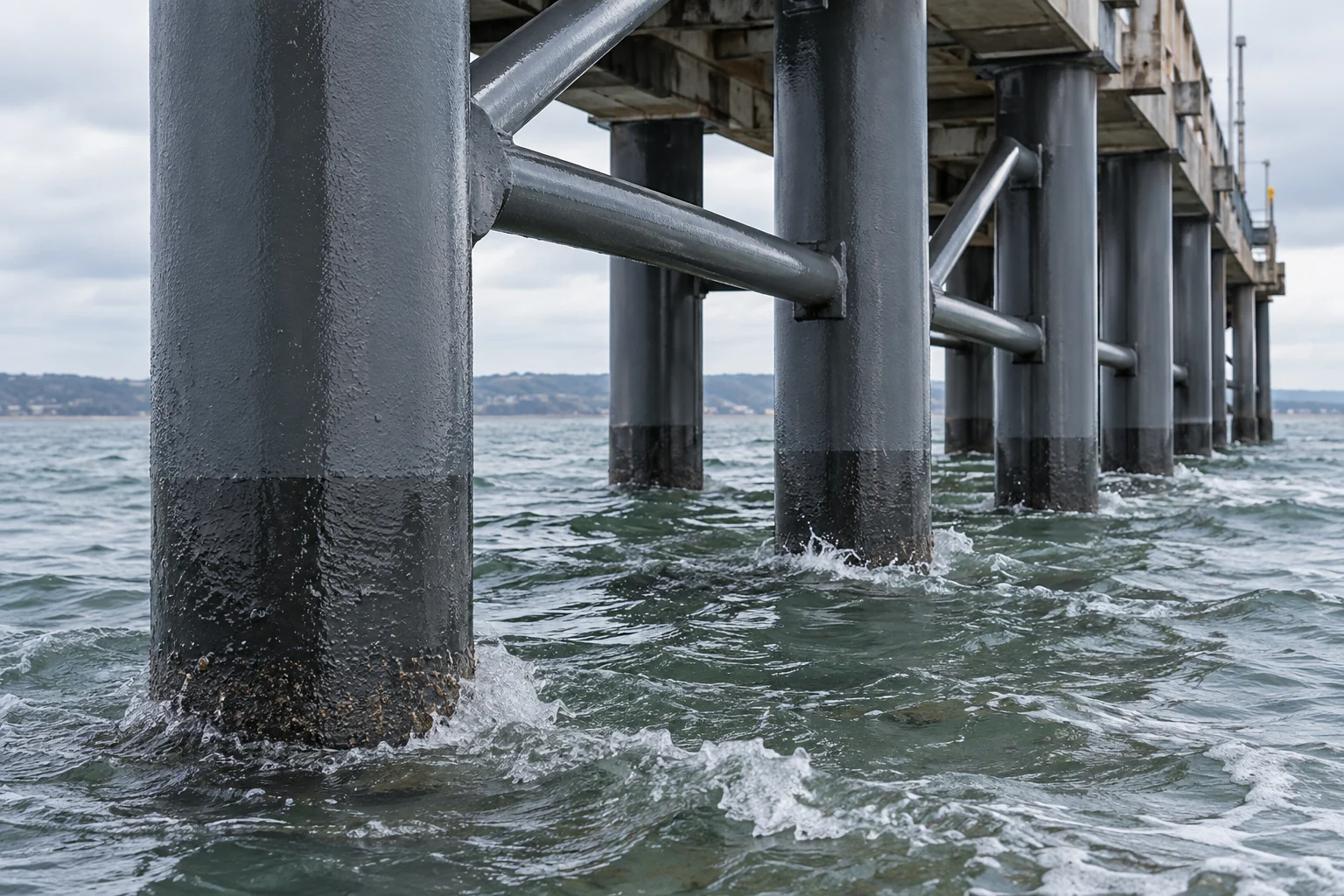
Severe splash and tidal exposure; permanent immersion requires separate project-specific assessment.

Fender Support Structures

Marine Mooring Dolphins

Wharf Substructures
Photographic visuals on this page are AI-generated application illustrations, not completed ALKA projects. Colours are illustrative. The system schematic is conceptual and not to scale; refer to current ALKA technical data and project specifications.