ALKA-9937
Severe-Duty Maintenance Protective Coating System
Heavy-duty surface-tolerant MIO glass-flake epoxy system designed for maintenance and refurbishment of existing steel assets exposed to severe industrial, coastal and highly corrosive atmospheric environments.
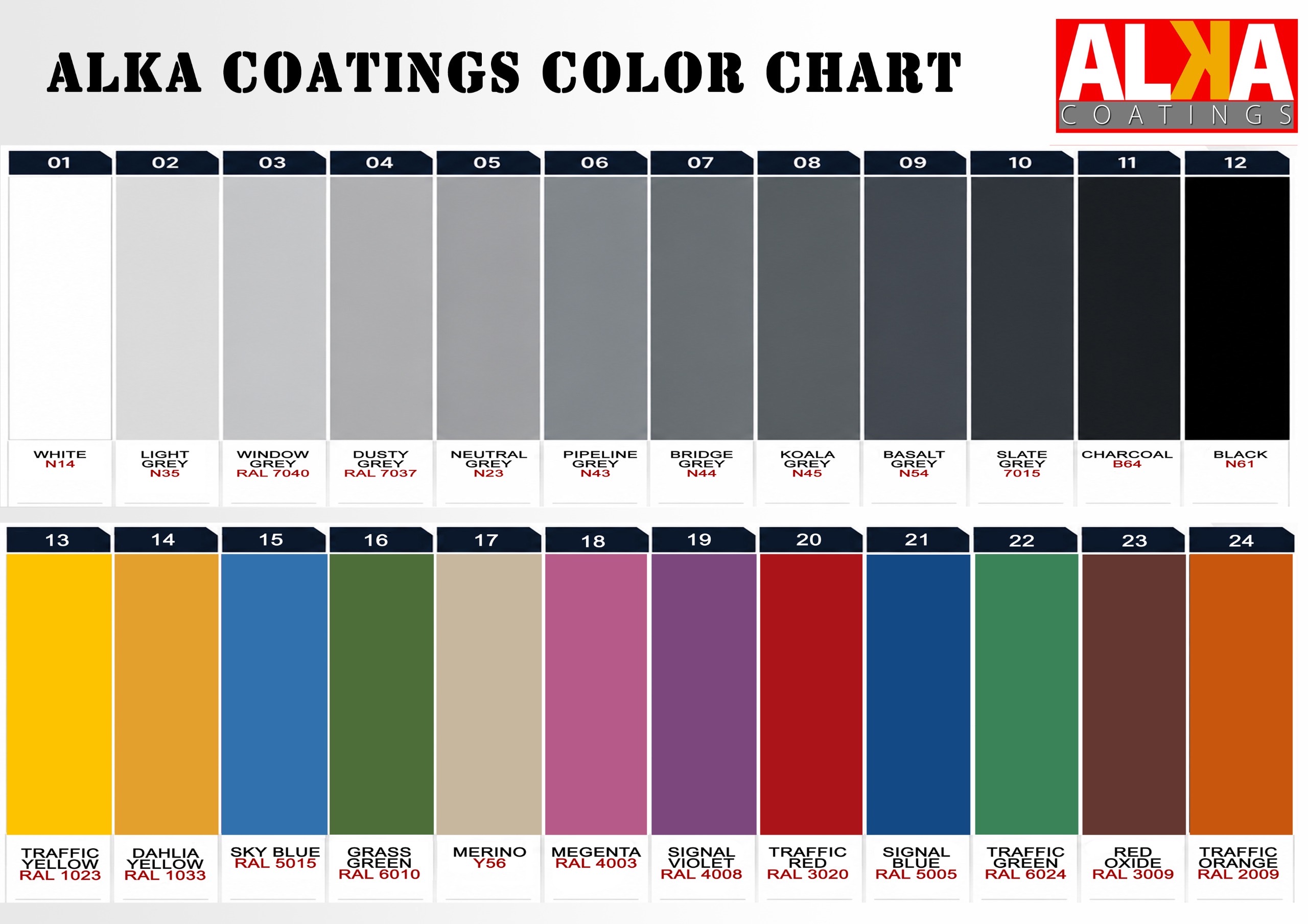
Available Colours
ALKA Coatings — Solid Colour Chart
Solid-colour reference for ALKA-9937. Confirm availability for the specified exposed coating and the project requirements. Colours shown are not automatically available in every primer, intermediate coat or specialist formulation.
View Colour Chart ↗ | Download Colour Chart ↓
Screen and printed colours are approximate. Confirm your final selection with a physical sample. Lighting, texture, application and the selected system can affect the finished appearance.
Severe-Duty Protection for Existing & Difficult-to-Maintain Steel
ALKA-9937 is a heavy-duty maintenance and refurbishment coating system developed for existing carbon steel structures where exposure conditions are severe and achieving ideal new-construction surface preparation may be difficult or impractical.
The system is based on ALKA-418 MIO Glass-Flake Surface-Tolerant Epoxy, normally applied in one or two high-build coats depending on substrate condition, exposure severity and the required total protective film thickness.
ALKA-9937 combines three important protective characteristics within a single coating technology: surface tolerance, MIO barrier reinforcement and glass-flake reinforcement.
This combination makes the system particularly suitable for ageing industrial steel assets that require more substantial protection than a conventional maintenance epoxy but where complete removal of the existing coating and installation of a full new-build system may create excessive cost, access problems or operational disruption.
ALKA-9937 is therefore positioned as the severe-duty maintenance system within the ALKA protective coating range, particularly for heavy industry, mining, processing plants, refineries, coastal industrial facilities and difficult-access steel infrastructure.
PROTECTION STRATEGY
ALKA-9937 uses a:
Existing Steel Assessment → Maintenance Surface Preparation → MIO Glass-Flake Surface-Tolerant Epoxy → Additional MIO Glass-Flake Epoxy Build Where Required
strategy.
Rather than depending on a separate conventional primer and intermediate barrier coat, ALKA-418 is designed to provide a combination of substrate tolerance and high-build reinforced barrier protection.
The protective strategy incorporates:
Surface-Tolerant Epoxy Technology
Allows the system to be used in appropriately prepared maintenance conditions where complete abrasive blasting may not always be practical.
MIO Barrier Reinforcement
Micaceous iron oxide contributes to the barrier characteristics of the coating film and helps create a more difficult pathway for atmospheric moisture and contaminants.
Glass-Flake Reinforcement
Glass flakes further increase the tortuous path through the coating film, improving the barrier concept and making the system particularly suitable for demanding maintenance environments.
The combination provides a substantially more robust maintenance barrier than a basic surface-tolerant epoxy system.
KEY PERFORMANCE BENEFITS
- Severe-duty maintenance and refurbishment system
- Surface-tolerant epoxy technology
- MIO reinforced barrier protection
- Glass-flake reinforced coating film
- High-build protective construction
- Suitable for ageing and corroded industrial steel
- Suitable where complete abrasive blasting is difficult
- Designed for severe industrial atmospheric environments
- Suitable for demanding coastal industrial environments where approved
- Suitable for heavy manufacturing and processing facilities
- Suitable for mining and mineral-processing infrastructure
- Suitable for refinery and petrochemical maintenance
- Excellent choice for difficult-access steel structures
- Suitable for shutdown maintenance programmes
- Suitable for localised corrosion repair and larger refurbishment projects
- One- or two-coat configuration depending on project requirements
- Reduced dependence on complex multi-product coating systems
- Substantial barrier protection from a maintenance-oriented coating technology
- Suitable where barrier performance is more important than decorative appearance
- Helps extend the service life of existing high-value industrial assets
- Practical alternative where complete blast-and-recoat replacement is not feasible
SYSTEM BUILD-UP
SUBSTRATE — Existing Prepared Carbon Steel / Compatible Existing Coating
ALKA-9937 is primarily designed for existing carbon steel requiring heavy-duty maintenance protection.
Before specifying the system, the asset should be assessed for:
- Extent of corrosion
- Corrosion depth and pitting
- Existing coating condition
- Existing coating adhesion
- Under-film corrosion
- Bare-steel areas
- Oil and grease contamination
- Industrial process contamination
- Soluble salts where relevant
- Moisture and condensation
- Accessibility
- Practical surface-preparation limitations
- Compatibility of retained coatings
- Structural integrity of the steel
The coating system must not be used to conceal structural deterioration. Steel that has suffered significant section loss or structural damage requires engineering assessment and repair independently of the coating specification.
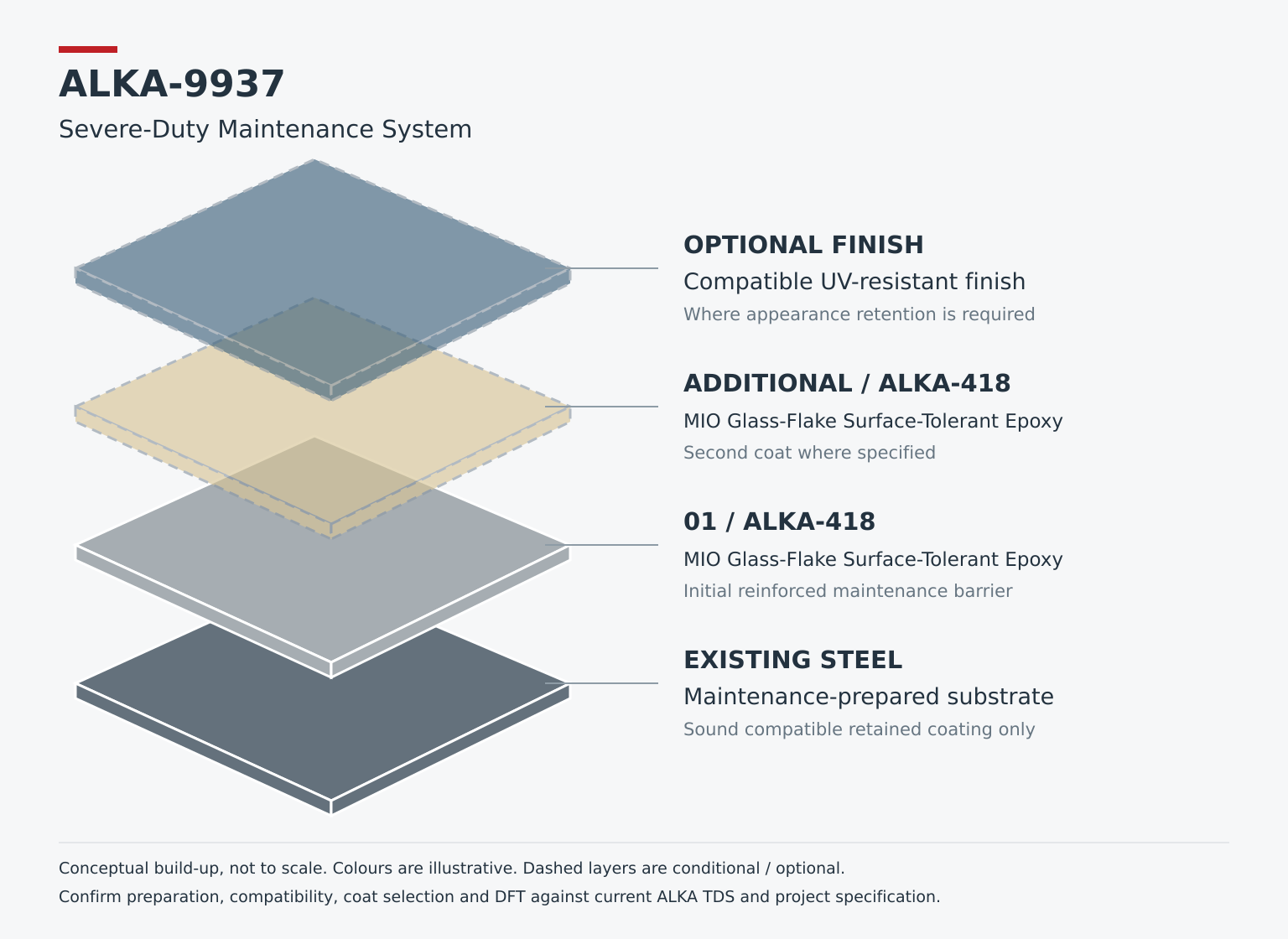
COAT 1 — ALKA-418 MIO Glass-Flake Surface-Tolerant Epoxy
Function: Initial Severe-Duty Surface-Tolerant Barrier Coat
The first coat of ALKA-418 is applied over the correctly prepared existing steel and any compatible retained coating approved to remain in place.
This first layer performs several functions simultaneously.
It establishes adhesion to the maintenance-prepared substrate, isolates the steel from the surrounding environment and creates the first high-build MIO/glass-flake reinforced protective barrier.
This is particularly important on ageing structures where the substrate may contain:
- Corrosion pits
- Irregular surface profile
- Retained compatible coating
- Bare-steel repair areas
- Welds
- Edges
- Complex connections
Product: ALKA-418 MIO Glass-Flake Surface-Tolerant Epoxy
Position: First maintenance / barrier coat
Primary Function: Surface-tolerant adhesion and reinforced high-build barrier protection
Nominal DFT: To project specification and current ALKA TDS
COAT 2 — ALKA-418 MIO Glass-Flake Surface-Tolerant Epoxy
Function: Additional Severe-Duty Reinforced Barrier
A second coat of ALKA-418 may be applied where the project requires greater total film thickness, improved coating continuity or enhanced barrier protection.
The second coat further increases the path through which moisture, oxygen and atmospheric contaminants must travel before reaching the steel substrate.
It also provides additional protective reserve over complex, irregular and heavily weathered steel surfaces.
Product: ALKA-418 MIO Glass-Flake Surface-Tolerant Epoxy
Position: Second reinforced barrier coat
Primary Function: Additional film build, barrier reinforcement and coating continuity
Nominal DFT: To project specification and current ALKA TDS
OPTIONAL COMPATIBLE FINISH COAT
Where ALKA-9937 is used externally and long-term colour or appearance retention is important, a compatible UV-resistant finish may be specified.
However, ALKA-9937 is primarily positioned as a functional severe-duty maintenance system, and the MIO/glass-flake epoxy may remain as the final exposed coating where appearance is secondary to protective performance.
Nominal Total System DFT: Project-Specific
The final DFT should be determined according to:
- Exposure severity
- Existing steel condition
- Surface-preparation standard
- Number of ALKA-418 coats
- Required service life
- Existing retained coating
- Project specification
- Accessibility for future maintenance
Final individual coat and total system thicknesses must be confirmed against the current ALKA-418 technical data sheet.
SUITABLE SUBSTRATES
ALKA-9937 is primarily intended for:
Existing Carbon Steel
Including:
- Weathered steel
- Corroded structural steel
- Previously coated steel
- Maintenance-prepared steel
- Power-tool prepared steel where approved
- Abrasive-blasted repair areas
- Compatible retained coating systems
Typical assets include:
- Structural beams
- Columns
- Pipe racks
- Conveyor structures
- Platforms
- Gantries
- Tank exteriors
- Processing-plant steelwork
- Equipment supports
- Steel frames
- Access structures
- Utility structures
- Heavy industrial infrastructure
Other substrates should be separately assessed before specification.
SERVICE & EXPOSURE ENVIRONMENT
ALKA-9937 is intended primarily for severe industrial maintenance environments.
Typical exposure conditions include:
- Heavy industrial atmosphere
- High humidity
- Frequent condensation
- Industrial airborne contamination
- Coastal industrial atmosphere
- Mining environments
- Mineral-processing facilities
- Refinery environments
- Petrochemical facilities
- Bulk materials-handling facilities
- Heavy manufacturing plants
- Externally exposed process infrastructure
- Difficult-access industrial steelwork
- Existing steel requiring extended maintenance life
The system is particularly useful where environmental severity and substrate condition make a conventional light-duty maintenance coating inadequate.
TYPICAL APPLICATIONS
Mining & Mineral Processing Plants
Existing structural steel within crushing, screening, processing and materials-handling facilities.
Typical assets include:
- Structural frames
- Equipment supports
- Conveyor structures
- Transfer structures
- Platforms
- Access steelwork
- Pipe supports
- Processing-area steel
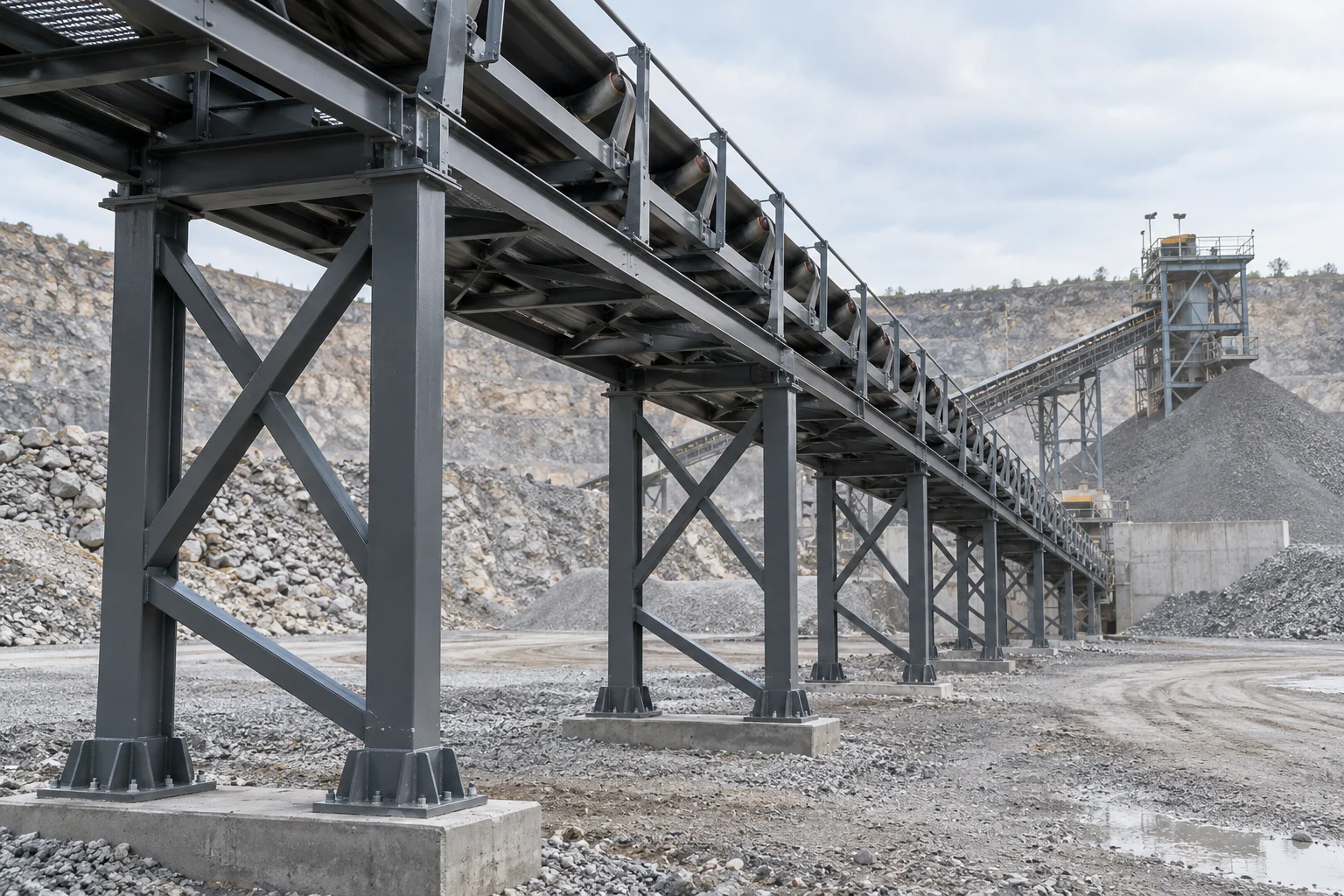
These environments can combine moisture, dust, industrial contamination and difficult maintenance access, making a reinforced maintenance barrier particularly valuable.
Conveyor Structures
Existing conveyor frames, trestles, support columns and transfer structures exposed to outdoor weather and industrial contamination.
Long conveyor systems can be expensive and difficult to completely blast and recoat, making a surface-tolerant maintenance approach particularly relevant.
Refinery Pipe Racks
Existing carbon-steel pipe racks, structural frames and pipe-support steelwork within refinery facilities.
Complex geometry, operating pipework and restricted access can make complete abrasive blasting difficult.
ALKA-9937 provides a severe-duty maintenance option for these structures where the actual exposure is compatible with the system.
Petrochemical Plant Steelwork
Platforms, structural frames, equipment supports, access structures and atmospheric steelwork within petrochemical facilities.
This application relates to atmospheric exposure, not direct chemical immersion or containment.
Heavy Manufacturing Facilities
Existing structural steel within steelworks, fabrication plants, manufacturing facilities and heavy industrial sites.
Typical assets include:
- Columns
- Beams
- Equipment supports
- Machinery frames
- Platforms
- Gantries
- Utility structures
Bulk Materials-Handling Facilities
Steel structures associated with:
- Conveyors
- Transfer stations
- Loading structures
- Storage facilities
- Processing equipment
- Materials-handling systems
These assets are often exposed to moisture, dust and industrial contamination while also being difficult to access for maintenance.
Industrial Tank Exteriors
Existing external tank shells, roofs, ladders, platforms and support structures requiring heavy-duty atmospheric maintenance protection.
This application refers specifically to external surfaces.
Tank internals and direct chemical immersion require a dedicated lining system.
Power & Utility Facilities
Existing structural steel, equipment supports, access structures and utility infrastructure exposed to demanding industrial atmospheric conditions.
Coastal Industrial Facilities
Existing steelwork located in salt-laden coastal industrial environments where a reinforced maintenance barrier is appropriate.
True marine splash, tidal or immersion zones should be assessed separately and should not automatically be specified with ALKA-9937.
Difficult-Access Steel Structures
Existing steel where complete abrasive blasting is restricted by:
- Height
- Complex geometry
- Operating equipment
- Pipework
- Restricted shutdown windows
- Adjacent sensitive equipment
- Access limitations
Shutdown Maintenance Projects
ALKA-9937 is particularly suited to planned industrial shutdowns where maintenance teams must achieve significant corrosion protection within limited access periods.
SURFACE PREPARATION
The term surface-tolerant does not mean that ALKA-418 can be applied over poorly prepared or contaminated steel.
Surface preparation remains fundamental to system performance.
The objective is to remove materials that could compromise adhesion while working within the practical limitations of an existing industrial asset.
Preparation should address:
- Loose rust
- Loose scale
- Failed coating
- Delaminated coating
- Oil
- Grease
- Dust
- Process contamination
- Soluble salts where relevant
- Corrosion products
- Sharp coating edges
- Weld contamination
- Moisture
- Condensation
The preparation method may vary according to project conditions and may include appropriate abrasive blasting, power-tool cleaning or other approved maintenance preparation.
EXISTING COATING ASSESSMENT
Where existing coating is to remain, it must be evaluated before overcoating.
Assessment should consider:
Adhesion
Loose or poorly adhered coating must be removed.
Compatibility
The retained coating must be compatible with ALKA-418.
Condition
Coatings exhibiting widespread blistering, cracking, delamination or under-film corrosion may not be suitable for retention.
Contamination
Existing coatings in industrial facilities can retain oils, chemicals, salts and process residues that must be removed before overcoating.
A test patch or adhesion assessment should be considered where compatibility is uncertain.
CORROSION PITS & IRREGULAR STEEL
Severely weathered steel often contains pits and irregular surface geometry.
These areas require particular attention because:
- Contaminants can remain within pits
- Air can become trapped
- Coating thickness may be uneven
- Application access can be difficult
- Local film discontinuities can develop
Corrosion pits should be thoroughly prepared and coated to achieve continuous coverage.
Deep structural corrosion should be assessed separately before coating.
TRANSITION AREAS
Where maintenance work includes both exposed steel and retained existing coating, transition areas must be carefully prepared.
Existing coating should be removed back to a sound edge and feathered where appropriate.
The new ALKA-418 coating should then form a continuous film across the transition.
Poorly prepared transition areas are a common location for premature maintenance-coating failure.
STRIPE COATING & DETAIL WORK
Where required by the project specification, stripe coating should be considered around:
- Welds
- Sharp edges
- Bolts
- Nuts
- Corners
- Brackets
- Connections
- Corrosion pits
- Difficult geometries
- Steel terminations
These areas frequently receive lower effective DFT during normal spray application and can become early corrosion initiation points.
APPLICATION CONSIDERATIONS
Application should comply with the current ALKA-418 technical data.
Important controls include:
- Ambient temperature
- Steel temperature
- Relative humidity
- Dew point
- Surface cleanliness
- Surface dryness
- Mixing ratio
- Mechanical mixing
- Pot life
- Application method
- Wet-film thickness
- Dry-film thickness
- Recoat interval
- Cure conditions
- Ventilation
- Protection from contamination between coats
High-build application must be controlled to achieve the specified DFT without excessive sagging, solvent entrapment or other film defects.
MIO & GLASS-FLAKE BARRIER CONCEPT
The key distinction of ALKA-9937 is the combination of MIO and glass-flake reinforcement within a surface-tolerant maintenance epoxy.
This creates a more complex pathway through the cured film than a conventional unreinforced maintenance coating.
The barrier concept is intended to reduce the rate at which environmental agents can reach the substrate.
This is particularly relevant to:
- Moisture
- Oxygen
- Atmospheric salts
- Industrial contaminants
The result is a maintenance system focused on barrier integrity and long-term industrial protection, rather than simply covering existing corrosion.
INSPECTION & QUALITY CONTROL
Quality control should be integrated into the maintenance process.
Depending on project requirements, inspection may include:
- Existing coating condition assessment
- Identification of corrosion areas
- Verification of coating removal
- Surface-preparation inspection
- Environmental-condition monitoring
- Dew-point measurement
- Inspection of corrosion pits
- Inspection of transition areas
- Stripe-coat verification
- Wet-film thickness measurement
- Dry-film thickness measurement
- Recoat-window verification
- Final total DFT measurement
- Inspection for missed or thin areas
- Final continuity inspection
- Batch-number recording
- Application-condition records
For severe-duty maintenance, inspection of the substrate before the first ALKA-418 coat is particularly important.
WHY SPECIFY ALKA-9937?
ALKA-9937 should be selected where a conventional maintenance coating does not provide the desired level of protection but installation of a complete new-build coating system is impractical.
The system combines:
Surface Tolerance + High Build + MIO Reinforcement + Glass-Flake Reinforcement
within a maintenance-oriented protective system.
Its coating logic is:
Existing Steel Assessment → Appropriate Maintenance Preparation → ALKA-418 → ALKA-418 Where Required
This makes it particularly suitable for large, ageing and difficult-to-maintain industrial assets.
WHEN TO CHOOSE ALKA-9937
ALKA-9937 is particularly appropriate when:
- Existing steel requires heavy-duty refurbishment
- Exposure is more severe than normal industrial maintenance conditions
- Complete abrasive blasting is difficult
- High-build protection is required
- MIO barrier reinforcement is desirable
- Glass-flake reinforcement is required
- The asset is difficult or expensive to access
- Plant downtime must be controlled
- Existing compatible coating may need to be retained
- Long-term maintenance performance is more important than decorative appearance
ALKA-9937 VS ALKA-9932
Both systems are designed for maintenance and refurbishment, but their severity level is different.
ALKA-9932
Uses:
ALKA-412 Surface-Tolerant Epoxy × 2 → Optional ALKA-421
and is positioned for general industrial maintenance and low-disruption refurbishment.
ALKA-9937
Uses:
ALKA-418 MIO Glass-Flake Surface-Tolerant Epoxy × 1–2
and is positioned for severe-duty industrial maintenance requiring reinforced high-build barrier protection.
In simple terms:
General maintenance & refurbishment → ALKA-9932
Severe-duty reinforced maintenance → ALKA-9937
ALKA-9937 VS ALKA-9935
ALKA-9935 is a glass-flake barrier lining system intended for steel or concrete where high-build lining performance is required and high-quality surface preparation can be achieved.
ALKA-9937 is specifically a surface-tolerant maintenance system for existing steel.
Therefore:
Purpose-designed heavy-duty lining → ALKA-9935
Existing steel / restricted preparation / severe maintenance → ALKA-9937
ALKA-9937 VS ALKA-9939
ALKA-9939 is specifically designed for marine splash and tidal exposure.
ALKA-9937 may be suitable for severe coastal industrial atmosphere, but it should not automatically be extended into direct seawater splash or tidal service.
Therefore:
Severe industrial/coastal maintenance → ALKA-9937
Direct marine splash/tidal exposure → ALKA-9939
LIMITATIONS
ALKA-9937 should not be interpreted as a preparation-free or universal severe-service coating.
Key limitations include:
- Surface-tolerant does not mean no surface preparation
- Loose rust and scale must be removed
- Unsound existing coatings must be removed
- Existing coating compatibility must be assessed
- Heavy contamination must be removed
- Structural corrosion damage requires separate repair
- Direct chemical immersion requires specialist assessment
- Internal chemical tank lining should use an appropriate Tanklin system
- Permanent seawater immersion requires specific system assessment
- Splash and tidal exposure should be treated as a separate marine category
- UV colour retention should not be assumed from an epoxy-only finish
- Service temperature must remain within product limitations
- High film thickness does not compensate for poor substrate preparation
SPECIFICATION GUIDANCE
A complete ALKA-9937 specification should define:
Existing Asset Condition → Corrosion Assessment → Existing Coating Assessment → Areas to Be Removed → Surface Preparation Method → Contamination Control → Bare-Steel Areas → Feathered Existing-Coating Transitions → Edge & Weld Preparation → Stripe Coating → ALKA-418 First Coat → ALKA-418 Second Coat Where Required → Individual DFT → Total System DFT → Optional Finish Requirement → Recoat Windows → Environmental Limits → Inspection → Acceptance Criteria
For major maintenance projects, the specification should also identify areas as:
Fully Prepared
Locally Repaired
Overcoated
Retained
Structurally Repaired
Excluded
This provides clear instructions to applicators and inspectors and reduces ambiguity during the project.
SYSTEM POSITIONING
ALKA-9937 should be presented to engineers, maintenance contractors and asset owners as:
A severe-duty MIO glass-flake surface-tolerant epoxy system for extending the service life of ageing industrial steel where high barrier performance is required but complete abrasive blasting may be impractical.
Its core value proposition is:
Surface tolerance + MIO barrier reinforcement + glass-flake reinforcement + high-build protection + practical severe-duty maintenance capability.
Application Examples
Representative applications; final system selection depends on substrate, preparation and service conditions.
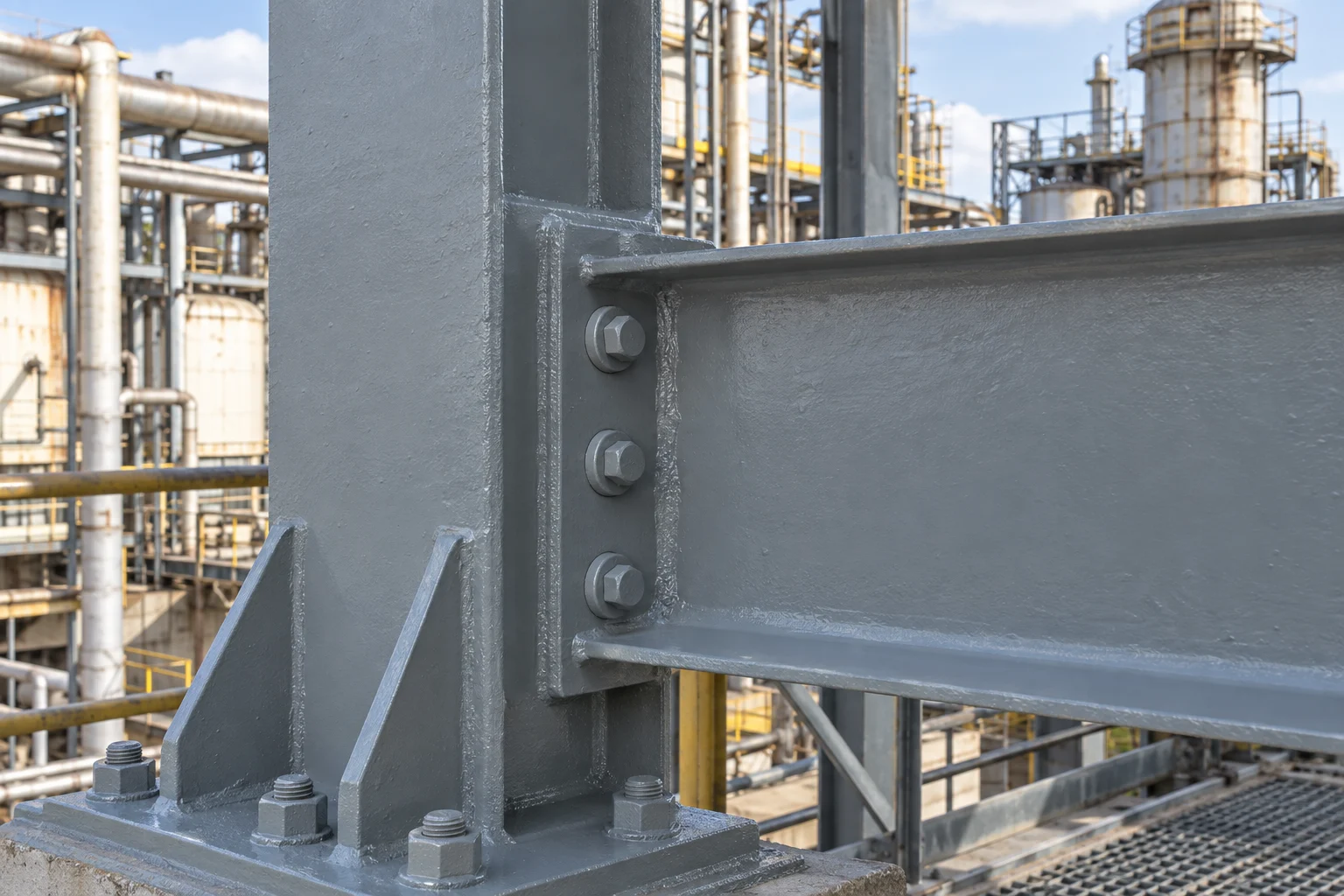
Existing Process-Plant Steelwork

Refinery Pipe-Rack Maintenance

Industrial Tank Exteriors
Photographic visuals on this page are AI-generated application illustrations, not completed ALKA projects. Colours are illustrative. The system schematic is conceptual and not to scale; refer to current ALKA technical data and project specifications.