ALKA-9933 — High-Barrier Atmospheric Protective Coating System
High-build epoxy barrier system designed for exposed structural steel requiring enhanced corrosion protection in industrial, marine-atmospheric and salt-laden environments above the waterline.
Available Colours
Specialist product colours
This system uses specialist protective or lining products. Colour availability depends on the specified exposed coating. Check the product pages below and confirm the required colour with ALKA; decorative flake blends do not apply to glass-flake barrier linings.
Screen and printed colours are approximate. Confirm your final selection with a physical sample. Lighting, texture, application and the selected system can affect the finished appearance.
High-Barrier Protection for Demanding Atmospheric Exposure
ALKA-9933 is a heavy-duty atmospheric protective coating system developed for prepared carbon steel exposed to industrial, coastal and marine-atmospheric environments above the waterline.
Technical selection notice: ALKA-416 is a zinc-rich primer, not the epoxy zinc-phosphate option previously listed for this build. Confirm any alternative non-zinc-rich primer, overcoating compatibility and film build with ALKA before specifying or ordering. See industrial coating products in Sydney for product supply.
The system combines either ALKA-404 Zinc-Rich Epoxy Primer or project-approved compatible non-zinc-rich primer with ALKA-413 MIO High-Build Epoxy Barrier Coat.
Its primary design objective is not decorative appearance. ALKA-9933 is built around high-barrier protection, using the primer to protect the steel interface and the MIO-containing epoxy layer to create a substantial protective barrier against moisture, oxygen and salt penetration.
The system is particularly appropriate for assets where exposure is more severe than normal industrial atmosphere but where the structure remains above permanent immersion and outside true splash/tidal service.
ALKA-9933 can remain as an MIO epoxy finish where colour and gloss are secondary. Where improved appearance or UV retention is required, a compatible finishing coat can be added as part of the project specification.
PROTECTION STRATEGY
ALKA-9933 uses a focused:
Corrosion-Protective Primer → MIO High-Build Barrier
strategy.
The system can be configured with one of two primer approaches depending on the project:
ALKA-404 Zinc-Rich Epoxy Primer
Used where a premium zinc-rich primary corrosion-protection layer is required.
or
project-approved compatible non-zinc-rich primer
Used only after ALKA confirms the selected primer is appropriate to the project specification and compatible with ALKA-413.
The selected primer is then overcoated with:
ALKA-413 MIO High-Build Epoxy
which forms the principal atmospheric barrier layer.
The MIO barrier technology is intended to improve resistance to penetration of moisture, oxygen and salt, providing a denser and more protective coating construction for aggressive atmospheric conditions.
KEY PERFORMANCE BENEFITS
- High-barrier protective coating system for prepared steel
- Designed for demanding industrial atmospheric exposure
- Suitable for marine-atmospheric environments above the waterline
- Suitable for salt-laden coastal environments
- Choice of ALKA-404 or a project-approved compatible alternative primer
- MIO high-build epoxy barrier technology
- Designed to reduce penetration of moisture, oxygen and salts
- Substantial protective film build
- Suitable for exposed structural steel
- Suitable for coastal infrastructure
- Suitable for refinery and chemical-plant steelwork
- Suitable where barrier performance is more important than decorative appearance
- Can remain as an MIO epoxy finish where colour and gloss are secondary
- Compatible finish coat can be added where appearance or UV retention is required
- Nominal system DFT of To approved project schedule
- Suitable for specification-driven industrial and marine-atmospheric projects
SYSTEM BUILD-UP
SUBSTRATE — Prepared Carbon Steel
ALKA-9933 is intended for prepared steel substrates exposed to demanding atmospheric conditions.
The steel must be appropriately prepared before coating to remove materials that could compromise adhesion or long-term corrosion protection.
The final surface-preparation standard and profile should be defined according to the project specification, selected primer and actual exposure environment.
Typical substrates include:
- Structural carbon steel
- Fabricated steel sections
- Bridge steelwork
- Wharf superstructures
- Pipe racks
- Platforms
- Steel frames
- Equipment support structures
- External process-plant steelwork
- Marine building steel structures
- General exposed industrial steel
Alternative primer pending technical confirmation. Ask ALKA for the current compatible grade and approved film build.
COAT 1 OPTION A — ALKA-404 Zinc-Rich Epoxy Primer
Function: Premium Primary Corrosion Protection
ALKA-404 can be selected as the first coat where the project requires a zinc-rich epoxy primer.
It is applied directly to correctly prepared steel and forms the initial corrosion-protection layer beneath the MIO epoxy barrier.
This primer option is particularly relevant where the specification places greater emphasis on primary steel protection or where the exposure severity justifies a zinc-rich foundation coat.
Product: ALKA-404 Zinc-Rich Epoxy Primer
Position: Directly over prepared steel
Primary Function: Primary corrosion protection
Nominal DFT: To project specification and current ALKA TDS
COAT 1 OPTION B — Project-Approved Compatible Non-Zinc-Rich Primer
Function: Corrosion-Inhibiting Epoxy Primer
An alternative primer may be used only after the current grade and compatibility have been confirmed by ALKA.
It provides the corrosion-inhibiting base coat and establishes adhesion between the prepared steel and the subsequent ALKA-413 MIO barrier coat.
This option provides flexibility in system specification depending on the required protection level, project economics and coating specification.
Product: project-approved compatible non-zinc-rich primer
Position: Directly over prepared steel
Primary Function: Corrosion inhibition and adhesion
Nominal DFT: To project specification and current ALKA TDS
COAT 2 — ALKA-413 MIO High-Build Epoxy Barrier Coat
Function: Principal High-Barrier Atmospheric Protection
ALKA-413 forms the primary barrier layer of ALKA-9933.
The MIO-containing high-build epoxy is designed to increase the protective path through the coating film and improve resistance to penetration of atmospheric moisture, oxygen and salts.
This is the core performance layer of the system.
The high-build epoxy construction provides substantial film thickness and makes ALKA-9933 particularly relevant where conventional thin-build atmospheric systems may not provide sufficient barrier performance.
Product: ALKA-413 MIO High-Build Epoxy
Position: Intermediate / exposed barrier coat
Primary Function: Moisture, oxygen and salt barrier protection
Nominal DFT: To project specification and current ALKA TDS
OPTIONAL COMPATIBLE FINISH COAT
ALKA-9933 may remain with the MIO epoxy layer as the exposed finish where:
- Colour is secondary
- Gloss retention is not important
- Functional protection takes priority over appearance
- The project accepts an industrial epoxy finish
Where better appearance, colour retention or UV performance is required, a compatible finish coat may be incorporated into the final specification.
The finish should be selected according to the required exterior appearance and service environment.
Nominal Total System DFT: To approved project schedule
The final total film build depends on the selected primer and the approved project schedule.
Final individual coat thicknesses must be confirmed against the current ALKA technical data sheets and project specification.
SUITABLE SUBSTRATES
ALKA-9933 is primarily intended for:
Prepared Carbon Steel
Typical components include:
- Structural beams
- Columns
- Cross-members
- Steel frames
- Pipe supports
- Pipe racks
- Tank exterior steelwork
- Gantries
- Platforms
- Access structures
- Wharf steelwork
- Bridge members
- Industrial process structures
- Marine-building structural steel
Other substrates should not automatically be assumed suitable under the same coating build.
SERVICE & EXPOSURE ENVIRONMENT
ALKA-9933 is specifically positioned for:
Industrial Atmospheric Exposure
Steel exposed to industrial humidity, atmospheric contamination and weather.
Marine-Atmospheric Exposure
Steel located in marine environments but above the waterline, where exposure is predominantly atmospheric rather than direct immersion.
Salt-Laden Coastal Atmosphere
Steel exposed to airborne salts and coastal moisture.
External Weathering
Steel structures exposed to rain, condensation and changing external atmospheric conditions.
The system should not be confused with a true splash-zone or tidal-zone system, where repeated direct seawater contact creates a substantially more aggressive exposure condition.
TYPICAL APPLICATIONS
Wharves — Above-Waterline Steelwork
Structural beams, deck-support steel, platforms, handrails, access structures and other wharf steelwork situated above the severe splash and tidal zones.
These areas may experience salt-laden air, high humidity and marine contamination without being continuously immersed.
Bridges
Steel bridge beams, girders, cross-members, structural supports and exposed fabricated steel requiring high-barrier atmospheric corrosion protection.
ALKA-9933 is particularly suited where the environment includes moisture, airborne salts or industrial atmospheric contamination.
Refineries
Pipe racks, structural frames, equipment supports, platforms, access structures and atmospheric steelwork within refinery environments.
These structures can be exposed to industrial contaminants, moisture and demanding outdoor conditions, making a high-barrier epoxy system appropriate.
Chemical Plants
Externally exposed structural steel within chemical manufacturing and processing facilities.
Typical applications include:
- Pipe-support structures
- Process-area platforms
- Structural frames
- Equipment-support steelwork
- Utility structures
- External access steel
ALKA-9933 is intended for atmospheric exposure in these facilities rather than direct chemical immersion or containment.
Exposed Industrial Steel Structures
Columns, beams, frames, braces and fabricated industrial structures exposed to outdoor weather and atmospheric contamination.
Marine Buildings
Structural steel associated with marine-side buildings, terminals and facilities where salt-laden atmosphere is a significant corrosion factor.
Typical examples include:
- Port buildings
- Wharf-side warehouses
- Marine maintenance facilities
- Coastal service buildings
- Terminal structures
Coastal Infrastructure
Steel assets located near the coastline and exposed to airborne salt, humidity and weather.
This can include:
- Structural frames
- Service platforms
- Gantries
- Access structures
- Equipment supports
- Utility steelwork
Industrial Pipe Racks
External pipe racks and pipe-support structures located in industrial or coastal facilities where a substantial atmospheric barrier system is required.
Tank Exteriors
External surfaces and associated structural steel of tanks exposed to industrial or coastal atmosphere.
This refers to external atmospheric protection only, not internal tank lining.
SURFACE PREPARATION
Surface preparation is fundamental to the performance of ALKA-9933.
The steel substrate should be prepared to the standard required by:
- The selected primer
- Project specification
- Exposure environment
- Required durability
- Current ALKA technical data sheets
The substrate should be assessed for:
- Oil and grease
- Mill scale
- Rust
- Existing coating residues
- Dust
- Abrasive contamination
- Soluble salts
- Marine contamination
- Weld spatter
- Sharp edges
- Burrs
- Poor weld profiles
- Surface defects
- Moisture
- Condensation
Because ALKA-9933 may be used in coastal and marine-atmospheric environments, salt contamination should receive particular attention.
EDGE, WELD & DETAIL PREPARATION
Premature coating breakdown often begins at locations where the effective coating thickness is lower than on flat surfaces.
Special attention should therefore be given to:
- Sharp edges
- Welds
- Bolts
- Nuts
- Corners
- Brackets
- Complex connections
- Difficult-access areas
- Steel terminations
Edges should be appropriately treated and stripe coating should be incorporated where required by the project specification.
APPLICATION CONSIDERATIONS
Application should be carried out in accordance with current ALKA product technical data.
Important variables include:
- Ambient temperature
- Steel temperature
- Relative humidity
- Dew point
- Surface dryness
- Surface cleanliness
- Mixing ratio
- Mechanical mixing
- Induction period where applicable
- Pot life
- Spray or application method
- Wet-film thickness
- Dry-film thickness
- Recoat interval
- Cure condition
- Ventilation
- Protection from contamination between coats
For coastal work, particular attention should be paid to environmental conditions and the possibility of salt deposition on prepared or partially coated surfaces.
MIO BARRIER PERFORMANCE
The principal technical feature of ALKA-9933 is the MIO high-build barrier layer.
The system guide specifically positions this technology as improving resistance to penetration by:
- Moisture
- Oxygen
- Salts
This makes ALKA-9933 particularly appropriate where the coating system must provide a robust physical barrier under demanding atmospheric exposure.
The barrier strategy is especially valuable for steel structures that are:
- Difficult to access for future maintenance
- Exposed to marine atmosphere
- Located in industrial environments
- Exposed to frequent condensation
- Subject to airborne salt contamination
INSPECTION & QUALITY CONTROL
A high-barrier coating system only performs as intended if the specified film build and surface preparation are actually achieved.
Inspection should therefore be integrated into the coating process.
Depending on project requirements, quality-control activities may include:
- Verification of surface-preparation standard
- Surface-profile measurement
- Soluble-salt assessment where required
- Environmental-condition monitoring
- Steel-temperature measurement
- Dew-point calculation
- Visual substrate inspection
- Stripe-coat inspection
- Wet-film thickness measurement
- Dry-film thickness measurement
- Recoat-window verification
- Inspection for thin areas
- Final total DFT measurement
- Inspection of complex geometry
- Final coating continuity and appearance inspection
- Batch-number recording
- Application-condition records
WHY SPECIFY ALKA-9933?
ALKA-9933 should be specified where the project requires high atmospheric barrier performance rather than a primarily decorative coating system.
The protective logic is:
Prepared Steel → ALKA-404 or an approved compatible primer → ALKA-413 MIO High-Build Epoxy
The primer protects the steel interface.
The ALKA-413 MIO layer provides the principal barrier to moisture, oxygen and salt penetration.
The result is a robust atmospheric coating system suited to demanding industrial and marine-influenced environments above the waterline.
WHEN TO CHOOSE ALKA-9933
ALKA-9933 is particularly appropriate when:
- The steel is exposed to demanding industrial atmosphere
- Salt-laden air is present
- Marine-atmospheric exposure exists
- The structure is above the waterline
- High-barrier epoxy performance is a priority
- A polyurethane decorative finish is not necessarily required
- MIO barrier technology is preferred
- The project requires a confirmed total system DFT
- The coating must protect structural steel in coastal infrastructure
- Appearance is secondary to barrier protection
ALKA-9933 VS ALKA-9930
Both systems can provide high-level atmospheric corrosion protection, but their emphasis is different.
ALKA-9930
Uses:
ALKA-404 → ALKA-413 → ALKA-421
and is positioned as a premium external system where corrosion protection, UV stability and finished appearance are all important.
ALKA-9933
Uses:
ALKA-404 or an approved compatible primer → ALKA-413 MIO
and is positioned as a high-barrier atmospheric system, where resistance to moisture, oxygen and salt penetration is the primary objective.
In simple terms:
Premium protection + architectural finish → ALKA-9930
High atmospheric barrier + functional industrial finish → ALKA-9933
ALKA-9933 VS ALKA-9938
ALKA-9933 and ALKA-9938 can both be relevant to marine-atmospheric exposure, but they should not be presented as identical.
ALKA-9933 emphasises MIO high-barrier atmospheric performance and may remain as an epoxy MIO finish.
ALKA-9938 is positioned specifically as the Marine Atmospheric Protective Coating System and incorporates a polyurethane finish as part of the standard system build.
This allows the final selection to account for both exposure and appearance requirements.
LIMITATIONS
ALKA-9933 is primarily an atmospheric protective coating system.
It should not automatically be specified for:
- Permanent seawater immersion
- Splash zones
- Tidal zones
- Submerged marine steel
- Internal tank lining
- Direct chemical containment
- Severe chemical immersion
- Buried steel without specific approval
- Substrates not approved for the selected primer
- Existing unknown coatings without compatibility assessment
Where high UV colour and gloss retention are required, an appropriate compatible topcoat should be specified rather than relying on the MIO epoxy finish alone.
SPECIFICATION GUIDANCE
A complete ALKA-9933 specification should define:
Substrate → Exposure Zone → Surface Preparation → Surface Profile → Salt/Contamination Requirements → Primer Selection (ALKA-404 or approved alternative) → Primer DFT → ALKA-413 MIO High-Build Epoxy → Barrier DFT → Nominal Total System DFT To approved project schedule → Optional Finish Requirement → Stripe Coating → Environmental Limits → Recoat Windows → Inspection → Acceptance Criteria
For marine-related projects, the specification should explicitly identify whether each area is:
Atmospheric
Splash Zone
Tidal Zone
Immersed
This prevents an atmospheric system from being incorrectly extended into a more severe exposure zone.
SYSTEM POSITIONING
ALKA-9933 should be presented to engineers, specifiers and asset owners as:
A high-barrier MIO epoxy protection system for prepared structural steel exposed to industrial, coastal and marine-atmospheric environments above the waterline.
Its core value proposition is:
Flexible primer selection + MIO high-build barrier + strong resistance to moisture, oxygen and salt penetration + robust industrial protection.
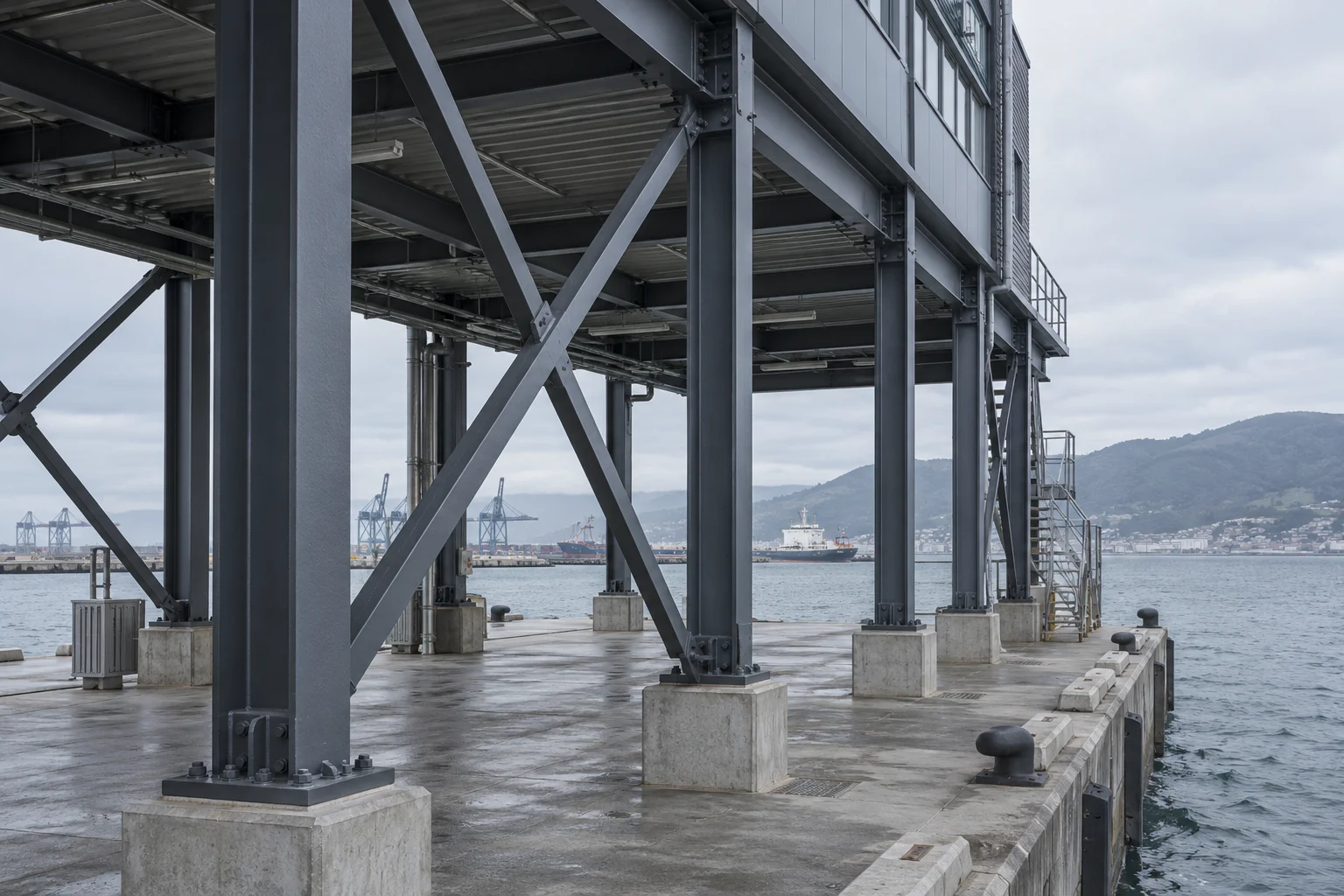
Application Examples
Atmospheric steelwork only; splash, tidal and immersion zones require separate assessment.

Bridge Steelwork

Industrial Pipe Racks

Above-Water Coastal Steelwork
Photographic visuals on this page are AI-generated application illustrations, not completed ALKA projects. Colours are illustrative. Alternative primer and film build require technical confirmation; refer to current ALKA technical data and project specifications.