ALKA-9938
Marine Atmospheric Protective Coating System
Premium three-coat corrosion protection system designed for above-water marine and coastal steelwork exposed to salt-laden atmosphere, high humidity, condensation, severe weathering and continuous UV exposure.
Premium Long-Term Protection for Marine & Coastal Atmospheric Steelwork
ALKA-9938 is a premium three-coat protective coating system developed specifically for prepared carbon steel exposed to marine and coastal atmospheric environments above the splash and tidal zones.
Marine-atmospheric environments create substantially more demanding corrosion conditions than normal inland exposure. Airborne chlorides, salt deposition, persistent humidity, condensation, rainfall and repeated wet/dry cycles can accelerate deterioration of unprotected steel and place significant demands on a protective coating system.
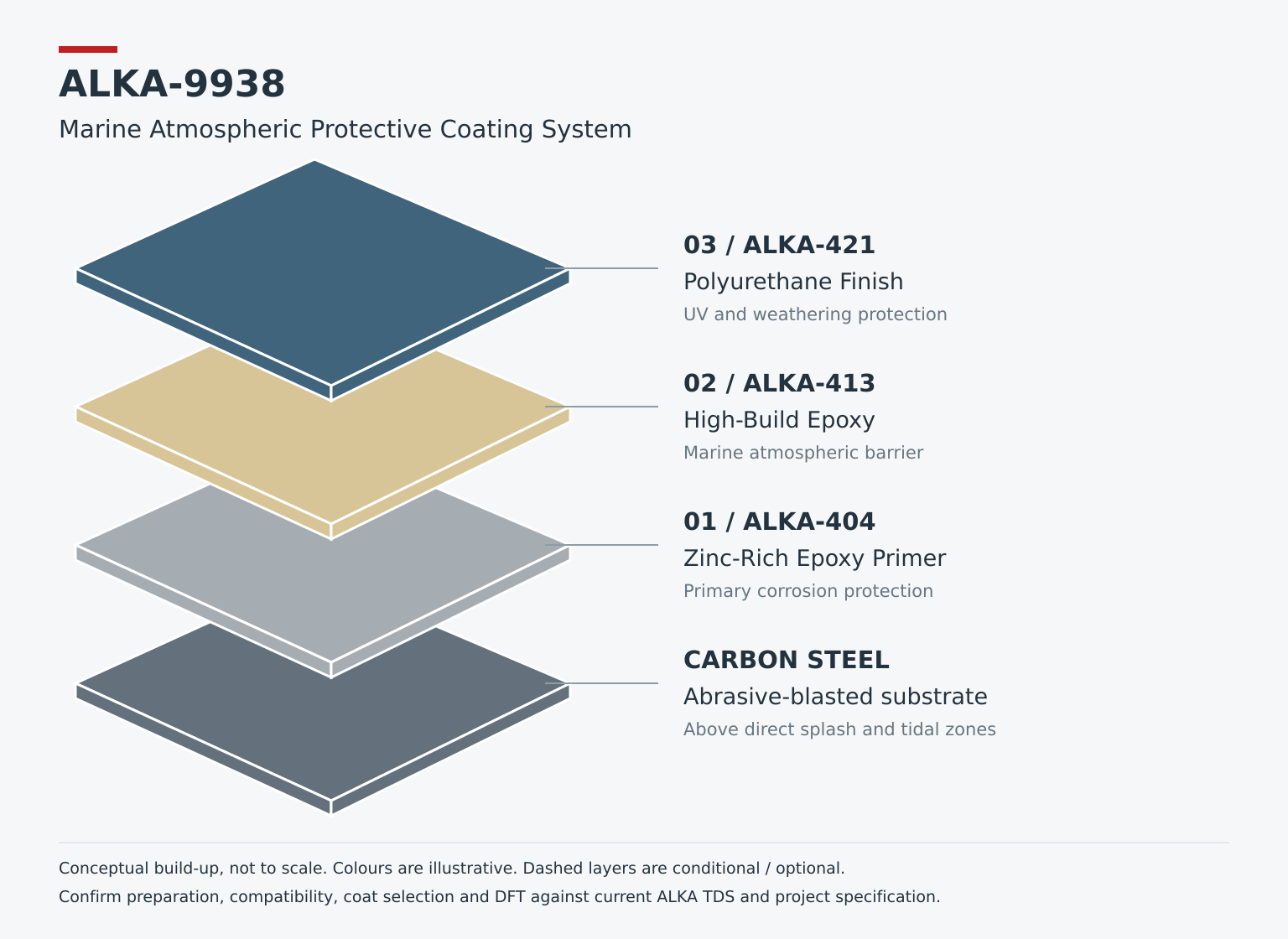
ALKA-9938 addresses these conditions through a complete three-stage protection strategy combining ALKA-404 Zinc-Rich Epoxy Primer, ALKA-413 High-Build Epoxy and ALKA-421 Polyurethane Finish.
ALKA-404 provides the primary corrosion-protection layer directly at the prepared steel surface. ALKA-413 then provides a substantial high-build epoxy barrier to reduce penetration of moisture and marine atmospheric contaminants. ALKA-421 completes the system with a durable polyurethane finish providing improved UV resistance, colour retention and exterior weathering performance.
The result is a robust protective system for high-value marine and coastal steel assets where corrosion protection, barrier performance, weatherability and long-term appearance must operate together.
PROTECTION STRATEGY
ALKA-9938 uses a:
Zinc-Rich Primary Protection → High-Build Epoxy Barrier → UV-Stable Polyurethane Weathering Finish
strategy.
Each coating performs a separate and complementary function.
Zinc-Rich Epoxy Primer
ALKA-404 provides the primary corrosion-protection layer directly over correctly prepared carbon steel.
High-Build Epoxy Barrier
ALKA-413 creates the principal physical barrier between the primed steel and the marine atmosphere, increasing total system film thickness and reducing penetration of moisture and atmospheric contaminants.
Polyurethane Weathering Finish
ALKA-421 protects the underlying epoxy system from direct exterior exposure while providing improved UV stability, colour retention and finished appearance.
This layered strategy is particularly important in marine environments because corrosion protection cannot depend on a decorative finish coat alone.
KEY PERFORMANCE BENEFITS
- Premium three-coat marine-atmospheric protection system
- Specifically designed for above-water coastal and marine steelwork
- Zinc-rich epoxy primary corrosion protection
- High-build epoxy intermediate barrier
- UV-resistant polyurethane exterior finish
- Suitable for salt-laden atmospheric exposure
- Suitable for high-humidity coastal environments
- Designed for repeated atmospheric wet/dry cycling
- Suitable for steel exposed to condensation and rainfall
- High total protective film build
- Good long-term colour retention
- Good exterior appearance retention
- Suitable for visible marine infrastructure
- Suitable for difficult-to-access structural steel
- Suitable for high-value port and harbour assets
- Suitable for new marine construction and major refurbishment
- Strong combination of corrosion protection and exterior durability
- Suitable where future maintenance access may be expensive
- Clear separation from specialist splash, tidal and immersion systems
SYSTEM BUILD-UP
SUBSTRATE — Abrasive-Blasted Carbon Steel
ALKA-9938 is primarily intended for carbon steel that can be correctly abrasive blasted before coating.
Marine coating performance is strongly influenced by the quality of surface preparation.
The steel must be clean, dry and free from:
- Rust
- Mill scale
- Oil and grease
- Dust
- Abrasive residues
- Existing failed coatings
- Weld contamination
- Soluble salts
- Chloride contamination
- Moisture
- Condensation
- Other substances capable of compromising adhesion or corrosion protection
The required blast-cleaning standard and surface profile should be defined by the project specification and current ALKA technical data.
COAT 1 — ALKA-404 Zinc-Rich Epoxy Primer
Function: Primary Corrosion-Protection Primer
ALKA-404 is applied directly to correctly prepared carbon steel and forms the foundation of ALKA-9938.
Its role is particularly important in marine-atmospheric environments because the steel/coating interface requires robust primary protection against aggressive chloride-containing exposure.
The zinc-rich epoxy primer establishes the initial corrosion-protection layer before the high-build barrier coats are applied.
Product: ALKA-404 Zinc-Rich Epoxy Primer
Position: Directly over abrasive-blasted carbon steel
Primary Function: Primary corrosion protection
Nominal DFT: To project specification and current ALKA TDS
COAT 2 — ALKA-413 High-Build Epoxy
Function: Principal Marine Atmospheric Barrier Coat
ALKA-413 forms the principal high-build barrier layer within ALKA-9938.
The epoxy intermediate coat increases the total protective film thickness and creates a substantial physical barrier between the zinc-primed steel and the external marine environment.
This layer is particularly important for reducing the ability of:
- Moisture
- Condensation
- Atmospheric salts
- Oxygen
- Industrial/coastal contaminants
to reach the underlying substrate.
Product: ALKA-413 High-Build Epoxy
Position: Intermediate barrier coat
Primary Function: High-build barrier protection
Nominal DFT: To project specification and current ALKA TDS
COAT 3 — ALKA-421 Polyurethane Finish
Function: UV-Resistant Marine Weathering & Appearance Coat
ALKA-421 forms the final exposed surface of ALKA-9938.
The polyurethane finish protects the epoxy system from direct sunlight and weather exposure while providing improved colour and gloss retention.
This is particularly valuable on visible marine structures such as wharves, terminals, port buildings, access structures and coastal industrial facilities.
Product: ALKA-421 Polyurethane Finish
Position: Final exposed coat
Primary Function: UV resistance, weatherability, colour retention and finished appearance
Nominal DFT: To project specification and current ALKA TDS
Nominal Total System DFT: Project-Specific
The final total system DFT should be established according to the marine exposure severity, project design life and current ALKA product technical data.
The specification should define the DFT of each individual coat rather than relying solely on an overall system thickness.
SUITABLE SUBSTRATES
ALKA-9938 is primarily intended for:
Abrasive-Blasted Carbon Steel
Typical assets include:
- Wharf superstructures
- Jetty superstructures
- Port structural steel
- Marine terminal steelwork
- Coastal structural frames
- Gantries
- Platforms
- Access structures
- Handrails
- Equipment supports
- Pipe racks
- Marine building steelwork
- Tank exteriors
- Coastal industrial infrastructure
Galvanised steel, stainless steel, aluminium and previously coated surfaces require separate assessment and potentially different primer selection.
SERVICE & EXPOSURE ENVIRONMENT
ALKA-9938 is specifically designed for marine atmospheric exposure above the splash and tidal zones.
Typical environmental conditions include:
- Salt-laden coastal air
- Airborne chloride deposition
- High relative humidity
- Frequent condensation
- Rainfall
- Repeated atmospheric wet/dry cycles
- Strong sunlight
- UV exposure
- Coastal winds
- Marine industrial contamination
- Exterior weathering
The system is particularly appropriate where steel is close enough to the sea to experience significant chloride contamination but is not directly subjected to regular seawater immersion or tidal cycling.
UNDERSTANDING MARINE EXPOSURE ZONES
Correct identification of the marine exposure zone is essential.
A marine structure may contain several fundamentally different exposure environments.
Atmospheric Zone
Steel located above direct seawater splash and exposed primarily to salt-laden air, humidity, rain and condensation.
ALKA-9938 is specifically designed for this zone.
Splash Zone
Steel repeatedly wetted by seawater spray, waves or severe splash.
This requires a more severe marine barrier system.
Tidal Zone
Steel repeatedly submerged and exposed as the water level changes.
This is a substantially more aggressive exposure and requires a dedicated system.
Immersion Zone
Steel permanently or predominantly submerged.
A specifically approved immersion coating system is required.
The same coating specification should not automatically be extended across all four zones.
TYPICAL APPLICATIONS
Wharf Superstructures
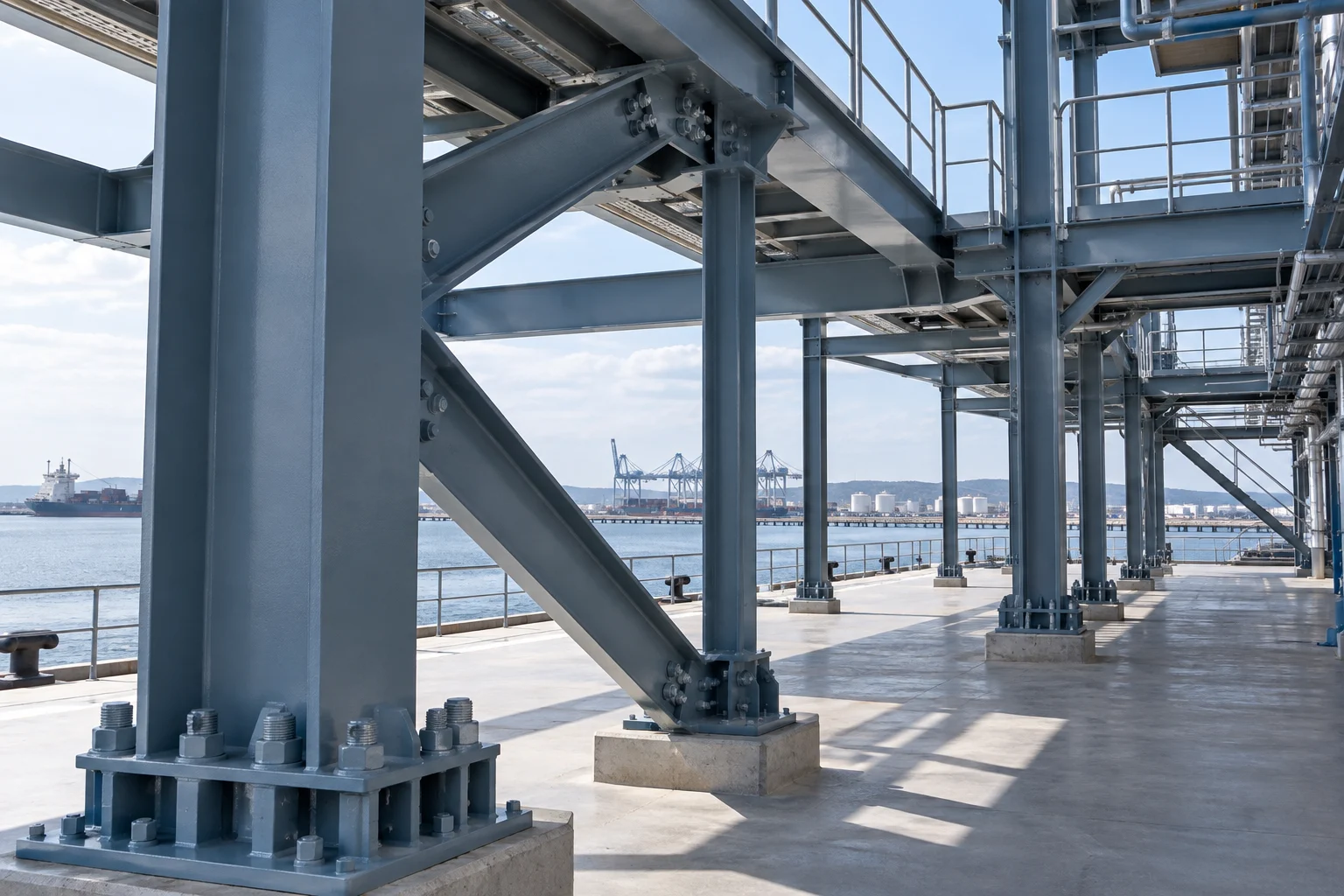
Above-water structural beams, columns, cross-members, platforms and support steelwork forming part of wharf infrastructure.
These structures can experience significant chloride deposition despite remaining above the direct tidal zone.
Jetty Superstructures
Structural steel located above the direct splash and tidal zones, including:
- Beams
- Platforms
- Access structures
- Support frames
- Handrails
- Equipment supports
Where structural elements extend downward into splash or tidal exposure, the coating specification should change at the defined exposure transition.
Port & Harbour Infrastructure
Above-water structural steel throughout ports and harbour facilities.
Typical applications include:
- Structural frames
- Access platforms
- Gantries
- Service structures
- Equipment supports
- Utility steelwork
- Loading-area structures
Marine Terminals
Externally exposed steelwork associated with bulk, container, fuel or industrial marine terminals.
Typical assets include structural frames, loading structures, service platforms and equipment-support steelwork located in marine atmosphere.
Coastal Industrial Facilities
Structural steel within industrial facilities located near the coastline and exposed to persistent salt-laden atmosphere.
Examples include:
- Processing facilities
- Coastal manufacturing plants
- Desalination facilities — atmospheric external steelwork
- Coastal utility facilities
- Port-side warehouses
- Marine maintenance facilities
Wharf-Side Warehouses & Buildings
External structural steel, frames, columns and visible steel components in buildings located immediately adjacent to marine environments.
Marine Equipment Support Structures
Frames and structural supports for equipment located in above-water marine environments.
This can include supports for:
- Pumps
- Mechanical equipment
- Electrical equipment
- Service equipment
- Loading systems
- Utility installations
Coastal Pipe Racks
External pipe racks and pipe-support structures exposed to coastal atmospheric conditions.
The system protects the structural steel supports; any process pipe coating should be selected according to its own operating conditions.
Above-Water Marine Gantries
Loading gantries, access gantries and fabricated steel structures located above direct seawater contact.
Marine Access Platforms & Walkways
Structural frames supporting platforms, walkways, ladders and access systems in marine facilities.
Tank Exteriors in Coastal Facilities
External shells, roofs and associated steelwork of storage tanks located in coastal or port environments.
This application refers to external atmospheric surfaces only.
Tank internals require a separate lining specification.
Coastal Bridges
Bridge steelwork located in coastal or salt-laden environments where the exposure remains atmospheric rather than direct tidal or immersion service.
SURFACE PREPARATION
Surface preparation is critical to the long-term performance of ALKA-9938.
Marine environments create an additional challenge because steel surfaces may contain soluble chloride contamination even when the surface appears visually clean.
Preparation should address:
- Rust
- Mill scale
- Oil
- Grease
- Dust
- Existing coatings
- Abrasive residues
- Chlorides
- Soluble salts
- Weld spatter
- Sharp edges
- Poor weld profiles
- Fabrication defects
- Moisture
- Condensation
Abrasive blasting should achieve the preparation standard and surface profile defined by the project specification.
SOLUBLE SALT & CHLORIDE CONTROL
Marine projects require particular attention to soluble surface contamination.
Chloride salts remaining beneath a coating system can contribute to premature coating failure and under-film corrosion.
Where required by the project specification, soluble salt testing should be undertaken after surface preparation.
If unacceptable contamination remains, additional cleaning and preparation may be required before coating.
This is particularly important during refurbishment of existing marine steel.
EDGE, WELD & FABRICATION DETAILING
Marine coating failures often begin at locations where film thickness is difficult to achieve.
Particular attention should therefore be given to:
- Sharp edges
- Welds
- Bolts
- Nuts
- Corners
- Brackets
- Crevices
- Steel connections
- Cut-outs
- Difficult-access areas
Edges should be appropriately treated and fabrication defects corrected before coating.
STRIPE COATING
Where required by the project specification, stripe coating should be applied to vulnerable details such as:
- Welds
- Edges
- Bolts
- Corners
- Brackets
- Complex connections
Stripe coating helps ensure adequate film build in areas where normal spray application may produce a thinner coating than on flat surfaces.
APPLICATION CONSIDERATIONS
Marine and coastal coating work requires careful environmental control.
Application should comply with the current technical data for ALKA-404, ALKA-413 and ALKA-421.
Important variables include:
- Ambient temperature
- Steel temperature
- Relative humidity
- Dew point
- Surface dryness
- Surface cleanliness
- Wind
- Salt deposition
- Mixing ratio
- Mechanical mixing
- Induction period where applicable
- Pot life
- Wet-film thickness
- Dry-film thickness
- Recoat intervals
- Cure conditions
- Protection from contamination between coats
Prepared or partially coated surfaces should not be allowed to become contaminated by marine salts before the next coating stage.
DEW POINT & CONDENSATION CONTROL
Coastal environments can experience rapid changes in humidity and steel temperature.
Condensation can form even when the surface does not initially appear wet.
Steel temperature and dew point should therefore be monitored before and during coating application according to the requirements of the relevant ALKA TDS and project specification.
Coating over condensation can severely compromise adhesion and long-term system performance.
RECOAT CONTROL
The correct recoat interval between:
ALKA-404 → ALKA-413 → ALKA-421
must be maintained.
Where the maximum recoat interval is exceeded, additional preparation may be required before applying the next coat.
The surface must also remain clean and free from:
- Salt
- Dust
- Overspray
- Oil
- Moisture
- Other contamination
between coating stages.
INSPECTION & QUALITY CONTROL
Specification-grade marine coating work should include documented inspection throughout the coating process.
Depending on project requirements, quality-control activities may include:
- Verification of abrasive-blast standard
- Surface-profile measurement
- Soluble-salt testing
- Visual inspection after blasting
- Environmental-condition monitoring
- Steel-temperature measurement
- Relative-humidity measurement
- Dew-point calculation
- Stripe-coat inspection
- Wet-film thickness measurement
- Dry-film thickness measurement
- Individual coat DFT verification
- Recoat-window verification
- Inspection for missed areas
- Inspection of welds and edges
- Final total system DFT measurement
- Final colour and appearance inspection
- Batch-number recording
- Application-condition records
For major marine infrastructure, inspection requirements should be defined before coating work begins.
WHY SPECIFY ALKA-9938?
ALKA-9938 should be specified when steel assets are exposed to a true marine or coastal atmosphere and require more than a general-purpose industrial coating system.
Its protection logic is:
ALKA-404 provides the zinc-rich primary protection at the steel interface.
ALKA-413 creates the substantial high-build epoxy barrier.
ALKA-421 provides the final UV-resistant weathering and appearance layer.
Together, these layers address the principal atmospheric challenges of marine infrastructure:
Chlorides + Moisture + Humidity + Condensation + Weather + UV
This makes ALKA-9938 particularly suitable for high-value coastal assets where corrosion failure would lead to expensive access, maintenance and disruption.
WHEN TO CHOOSE ALKA-9938
ALKA-9938 is particularly appropriate when:
- Steel is located close to the sea
- Airborne chloride exposure is significant
- The asset remains above the splash and tidal zones
- High humidity and condensation are expected
- Zinc-rich primary protection is required
- High-build epoxy barrier protection is required
- UV stability is important
- Colour retention is required
- The asset is visible
- Maintenance access is difficult or expensive
- A premium three-coat marine-atmospheric system is required
ALKA-9938 VS ALKA-9930
ALKA-9930 and ALKA-9938 use a similar premium three-coat protection philosophy.
However, their positioning is different.
ALKA-9930
is the broader Premium External Protective Coating System for exposed structural steel.
ALKA-9938
is specifically positioned for marine and coastal atmospheric exposure, with particular emphasis on chloride contamination, salt-laden air, high humidity and marine environmental control.
Therefore:
Premium general external steel protection → ALKA-9930
Dedicated marine/coastal atmospheric protection → ALKA-9938
ALKA-9938 VS ALKA-9933
ALKA-9933 is a high-barrier MIO atmospheric system where functional barrier protection is the main objective.
ALKA-9938 is a complete premium marine-atmospheric system with polyurethane finish.
Therefore:
Functional MIO high-barrier atmospheric protection → ALKA-9933
Premium marine protection + UV-stable finished appearance → ALKA-9938
ALKA-9938 VS ALKA-9939
This distinction is particularly important.
ALKA-9938
is designed for:
Marine Atmospheric Zone
Steel above the direct splash/tidal environment.
ALKA-9939
is designed for:
Splash & Tidal Zones
Steel exposed directly and repeatedly to seawater.
Therefore:
Salt-laden air / coastal atmosphere → ALKA-9938
Direct seawater splash / tidal cycling → ALKA-9939
On a single wharf or jetty project, both systems may therefore be specified on different sections of the same structure.
LIMITATIONS
ALKA-9938 should not automatically be specified for:
- Splash zones
- Tidal zones
- Permanent seawater immersion
- Submerged steel
- Internal ballast or process tanks
- Chemical tank lining
- Direct chemical containment
- Buried steel without specific assessment
- Substrates not approved for ALKA-404
- Existing coatings without compatibility assessment
- Areas where full marine surface preparation cannot be achieved without project-specific review
The exposure zone must be correctly identified before final system selection.
SPECIFICATION GUIDANCE
A complete ALKA-9938 project specification should define:
Substrate → Marine Exposure Zone → Surface Preparation Standard → Surface Profile → Soluble Salt / Chloride Limits → Edge & Weld Preparation → Stripe Coating → ALKA-404 Zinc-Rich Epoxy Primer → Primer DFT → ALKA-413 High-Build Epoxy → Barrier DFT → ALKA-421 Polyurethane Finish → Finish DFT → Total System DFT → Colour / Gloss → Environmental Limits → Dew Point Requirements → Recoat Windows → Inspection → Acceptance Criteria
For major marine projects, the coating schedule should clearly divide the structure into:
Atmospheric Zone → Splash Zone → Tidal Zone → Immersion Zone
and specify the appropriate coating system for each.
SYSTEM POSITIONING
ALKA-9938 should be presented to marine engineers, asset owners, port authorities and protective-coating contractors as:
A premium zinc-rich epoxy / high-build epoxy / polyurethane system specifically designed for long-term protection of above-water marine and coastal steelwork exposed to salt-laden atmosphere, humidity and UV weathering.
Its core value proposition is:
Zinc-rich primary protection + high-build epoxy barrier + UV-stable polyurethane finish + marine-specific atmospheric protection + long-term asset durability.
Application Examples
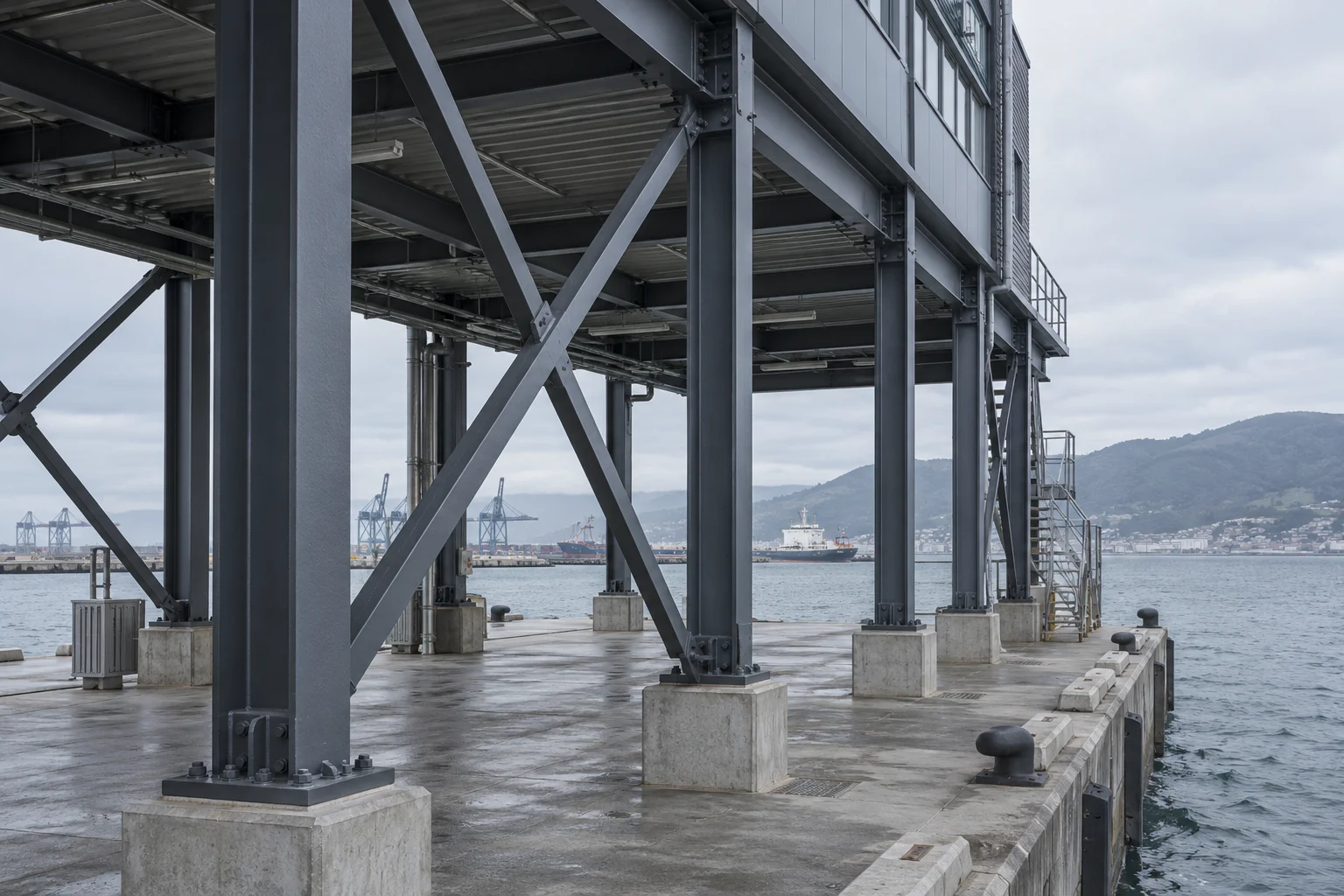
Atmospheric steelwork only; splash, tidal and immersion zones require separate assessment.

Above-Water Marine Gantries
Port-Side Buildings

Coastal Bridge Steelwork
Photographic visuals on this page are AI-generated application illustrations, not completed ALKA projects. Colours are illustrative. The system schematic is conceptual and not to scale; refer to current ALKA technical data and project specifications.