ALKA-9935
Glass-Flake Barrier Lining System
Heavy-duty glass-flake reinforced epoxy lining system designed to provide high-build barrier protection for steel and concrete exposed to severe industrial, wet-service and corrosive environments.
Heavy-Duty Reinforced Barrier Protection for Severe Industrial Service
ALKA-9935 is a specialist high-build protective lining system developed for steel and concrete assets requiring substantially greater barrier protection than conventional thin-film industrial coatings.
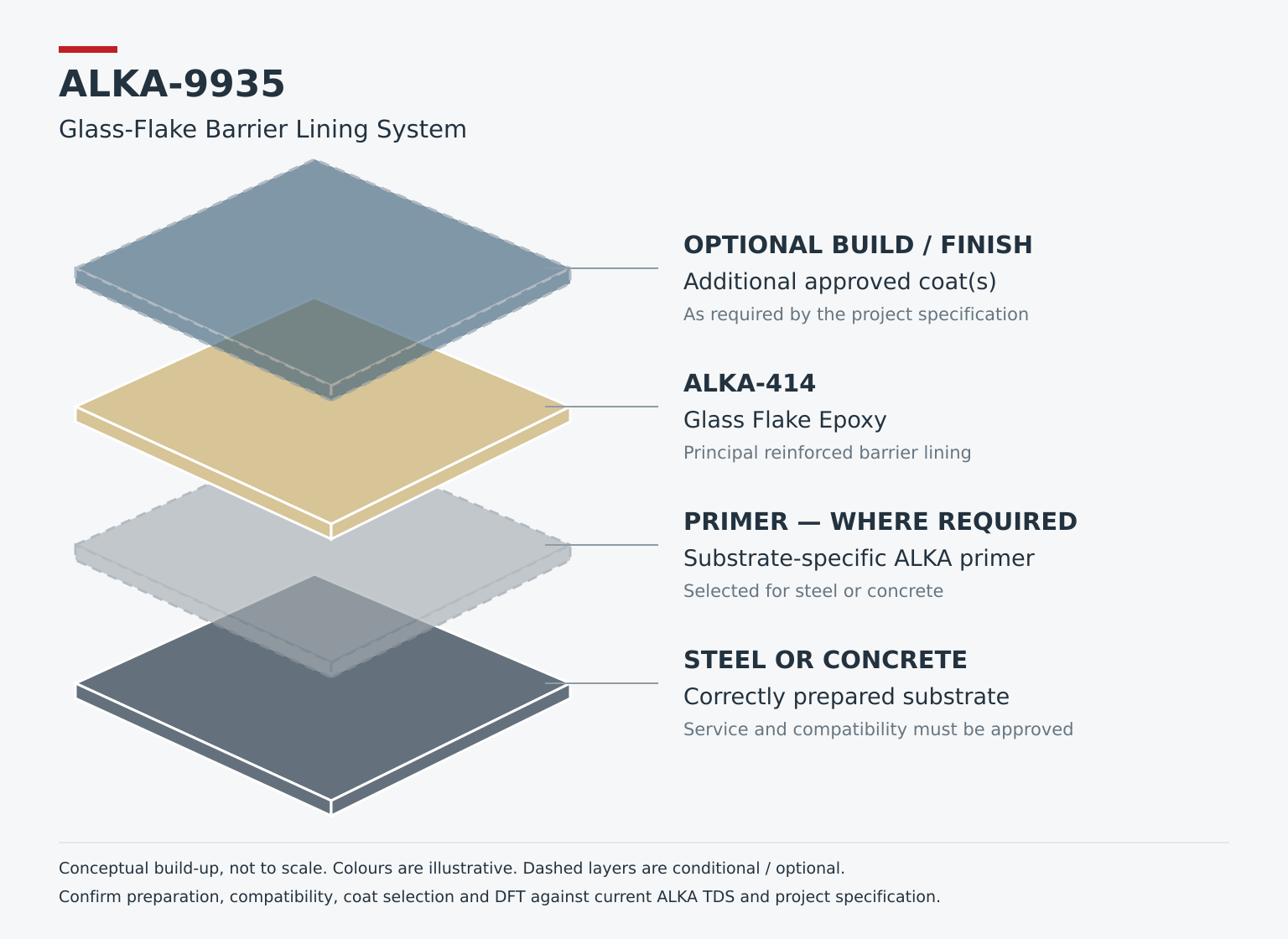
The system is based around ALKA-414 Glass Flake Epoxy, used with a substrate-specific ALKA primer where required and additional approved build or finish coats where demanded by the project specification.
The defining feature of ALKA-9935 is the incorporation of glass-flake reinforcement within the epoxy barrier layer. The dispersed glass flakes increase the effective path that moisture and other aggressive species must travel through the coating film, helping create a denser and more resistant protective barrier.
This makes ALKA-9935 particularly suitable for demanding industrial environments where high film build, low permeability, strong barrier performance and long-term substrate protection are the primary requirements.
The system is intended for projects where conventional primer-and-topcoat atmospheric systems are not sufficient and where the asset requires a more substantial lining-type protective build.
PROTECTION STRATEGY
ALKA-9935 uses a:
Prepared Substrate → Substrate-Specific Primer → Glass-Flake Reinforced High-Build Epoxy Barrier → Optional Additional Build / Finish
strategy.
The primer is selected according to the substrate and exposure conditions.
The ALKA-414 Glass Flake Epoxy then forms the principal protective layer and provides the high-build reinforced barrier that defines the system.
Where required, additional coats or an approved compatible finish may be incorporated to achieve the required total film build, service performance or appearance.
The system is therefore not a fixed decorative coating build. It is a project-engineered barrier lining system.
KEY PERFORMANCE BENEFITS
- Heavy-duty glass-flake reinforced epoxy lining system
- High-build protective barrier construction
- Suitable for prepared carbon steel
- Suitable for appropriately prepared concrete
- Increased barrier path through glass-flake reinforcement
- Reduced permeability compared with conventional thin-film coating systems
- Suitable for severe industrial exposure
- Suitable for demanding wet-service environments where approved
- Excellent choice for assets requiring substantial protective film thickness
- Strong resistance to moisture penetration
- Suitable for process and containment infrastructure
- Suitable for high-value industrial assets
- Suitable where coating access for future maintenance may be difficult
- Project-specific primer selection
- Project-specific DFT selection
- Can be configured with additional barrier coats where required
- Suitable for complex steel and concrete structures
- Provides reinforced protection where standard atmospheric systems may be insufficient
- Suitable for both new construction and major refurbishment where correct preparation can be achieved
SYSTEM BUILD-UP
SUBSTRATE — Prepared Carbon Steel or Concrete
ALKA-9935 can be specified over carbon steel or concrete, but the preparation requirements and primer selection differ significantly between the two substrate types.
The substrate must therefore be identified clearly before finalising the coating specification.
STEEL SUBSTRATE PREPARATION
Steel must be properly prepared to remove:
- Rust
- Mill scale
- Oil and grease
- Dust
- Soluble contamination
- Existing failed coating
- Weld spatter
- Sharp edges
- Burrs
- Fabrication defects
- Moisture and condensation
The required blast-cleaning standard and surface profile should be established according to the project specification and the current ALKA-414 technical data.
For severe lining service, the quality of surface preparation is particularly important because defects at the coating/substrate interface can undermine the performance of a high-build lining system.
CONCRETE SUBSTRATE PREPARATION
Concrete must be:
- Structurally sound
- Clean
- Free from laitance
- Free from curing compounds
- Free from oil and grease
- Free from weak or friable material
- Sufficiently dry or otherwise suitable for the specified primer
- Mechanically prepared to provide an appropriate surface profile
Cracks, blowholes, honeycombing, pinholes and other defects must be repaired before lining application.
Concrete may also require filling, fairing or pore-sealing treatments to achieve a continuous lining surface.
PRIMER — SUBSTRATE-SPECIFIC ALKA PRIMER
Function: Adhesion, substrate sealing and system compatibility
A substrate-specific primer is incorporated where required.
The primer should be selected according to:
- Steel or concrete substrate
- Surface condition
- Moisture condition
- Required adhesion
- Service environment
- Chemical exposure
- Application method
- Project specification
The primer forms the interface between the prepared substrate and the ALKA-414 glass-flake barrier layer.
Product: Project-approved ALKA primer
Position: Directly over prepared substrate
Primary Function: Adhesion, substrate sealing and compatibility
Nominal DFT: Project-specific / current ALKA TDS
BARRIER COAT — ALKA-414 Glass Flake Epoxy
Function: Principal High-Build Reinforced Barrier
ALKA-414 is the core performance layer of ALKA-9935.
The glass-flake reinforced epoxy forms a dense, high-build protective film intended to reduce penetration of moisture and other aggressive environmental species.
Rather than relying only on total coating thickness, the glass flakes create a more complex pathway through the cured film.
This makes ALKA-414 particularly suitable where the asset requires a more substantial barrier than can be achieved with a conventional high-build epoxy alone.
Product: ALKA-414 Glass Flake Epoxy
Position: Main barrier / lining coat
Primary Function: High-build reinforced barrier protection
Nominal DFT: To project specification and current ALKA TDS
OPTIONAL SECOND ALKA-414 COAT
Where greater total film build or additional barrier reinforcement is required, a second ALKA-414 coat may be incorporated.
This may be appropriate where:
- Exposure severity is higher
- The substrate geometry is complex
- Greater barrier thickness is required
- The project specifies multiple reinforced layers
- Additional coverage is required over irregular substrates
- Lining continuity is particularly critical
The decision should be based on the actual service environment and project specification.
OPTIONAL APPROVED FINISH
A compatible approved finish may be specified where the project requires:
- Improved colour retention
- UV stability
- Easier inspection
- Specific appearance
- Additional wear characteristics
- Project-specific chemical resistance
The finish must be compatible with the ALKA-414 lining and suitable for the intended service.
Nominal Total System DFT: Project-Specific
ALKA-9935 does not have one universal total DFT.
The correct total system thickness should be selected according to:
- Substrate
- Exposure environment
- Immersion or non-immersion service
- Chemical exposure
- Wet-service conditions
- Required durability
- Number of ALKA-414 coats
- Inspection requirements
- Project design life
Final individual coat DFTs and total system DFT must be confirmed against current ALKA technical data and the project specification.
SUITABLE SUBSTRATES
ALKA-9935 can be considered for:
Prepared Carbon Steel
Including:
- Tank shells
- Vessel surfaces
- Process equipment
- Steel pits
- Industrial steel structures
- Severe wet-service steelwork
- Steel containment assets
Prepared Concrete
Including:
- Process pits
- Bunds
- Containment structures
- Sumps
- Concrete tanks
- Industrial wastewater structures
- Severe-service concrete surfaces
Substrate-specific preparation and primer selection are essential.
SERVICE & EXPOSURE ENVIRONMENT
ALKA-9935 is intended for high-barrier industrial service.
Potential exposure categories include:
- Severe industrial environments
- Persistent moisture
- Wet-service exposure
- Industrial splash
- Process contamination
- High-humidity service
- Aggressive industrial atmosphere
- Selected containment environments
- Selected immersion service where specifically approved
- Severe external or internal barrier applications
The system should not be marketed as universally chemical-resistant. Chemical compatibility must be assessed separately where chemicals are part of the service environment.
TYPICAL APPLICATIONS
Industrial Tank Exteriors
External steel tank shells and associated steelwork requiring substantially greater barrier performance than a conventional atmospheric coating system.
This can be particularly relevant in wet, contaminated or aggressive industrial environments.
Selected Tank Internals
Internal steel tank surfaces where ALKA-414 has been specifically reviewed and approved for the actual stored medium.
Internal lining must never be specified solely because the product is glass-flake reinforced. Compatibility with the stored material must be confirmed.
Process Vessels
Steel process vessels requiring a high-build reinforced barrier against severe moisture or process exposure.
The precise service environment must be reviewed before specification.
Industrial Bunds
Concrete or steel secondary-containment areas where a substantial barrier lining is required.
Any direct chemical exposure must be checked against the actual chemical service.
Process Pits
Concrete or steel process pits exposed to persistent industrial moisture, washdown or compatible process contamination.
Industrial Sumps
Sumps requiring a continuous high-build barrier over appropriately prepared concrete or steel.
Wastewater Structures
Selected wastewater assets where the ALKA-414 system is compatible with the expected exposure.
Typical structures can include:
- Process chambers
- Pits
- Sumps
- Selected treatment structures
- Wet industrial areas
For highly aggressive wastewater, H₂S or acid exposure, a specialist chemical-resistant system such as ALKA-9936 or another project-specific lining may be more appropriate.
Pump Stations
Selected concrete or steel pump-station surfaces requiring heavy-duty barrier protection against wet industrial service.
Process Equipment
Equipment shells, steel housings and fabricated process components requiring reinforced epoxy barrier protection.
Industrial Floors & Plinths — Where Specifically Designed
Selected industrial concrete plinths, bases or surfaces requiring high-build barrier protection rather than a standard flooring system.
This should be project-specific and should not replace a purpose-designed flooring system where mechanical traffic is the primary exposure.
Containment Structures
Steel or concrete secondary-containment surfaces where the exposure is compatible with the selected lining build.
High-Humidity Industrial Facilities
Steel or concrete assets continuously exposed to condensation and elevated humidity.
Marine-Influenced Industrial Assets
Selected above-water or sheltered marine-industrial structures requiring a reinforced epoxy barrier.
True splash/tidal exposure should instead be assessed against ALKA-9939.
SURFACE PREPARATION
The performance of ALKA-9935 is strongly dependent on surface preparation.
A high-build glass-flake lining cannot compensate for:
- Unsound steel
- Poorly adhered contamination
- Weak concrete
- Moisture-related failure
- Loose corrosion
- Excessive salts
- Structural cracking
- Failed repairs
Preparation must therefore be appropriate to the substrate and service.
STEEL DETAILING
For steel substrates, attention should be given to:
- Welds
- Edges
- Corners
- Bolts
- Brackets
- Crevices
- Pits
- Difficult-access areas
Sharp edges should be treated appropriately and stripe coating may be required before application of the full lining coat.
CONCRETE DETAILING
Concrete lining work requires careful treatment of:
- Blowholes
- Pinholes
- Cracks
- Construction joints
- Honeycombing
- Bugholes
- Surface voids
- Penetrations
- Corners
- Wall/floor transitions
These defects can create discontinuities in the lining and should be repaired before application.
APPLICATION CONSIDERATIONS
Application should be carried out according to the current technical data sheets for the selected primer and ALKA-414.
Critical variables include:
- Ambient temperature
- Substrate temperature
- Relative humidity
- Dew point
- Concrete moisture condition
- Surface cleanliness
- Mixing ratio
- Mechanical mixing
- Pot life
- Application method
- Wet-film thickness
- Dry-film thickness
- Recoat interval
- Cure requirements
- Ventilation
- Access for inspection
Because ALKA-414 is a high-build lining, applicators must ensure the required film thickness is achieved without excessive sagging, pinholing or other film defects.
FILM CONTINUITY
For high-barrier lining systems, continuity of the cured film is critical.
A thick coating is not necessarily an effective barrier if it contains:
- Pinholes
- Holidays
- Missed areas
- Voids
- Thin spots
- Craters
- Defects around welds
- Poorly coated corners
The completed lining must therefore be inspected for continuity as required by the project specification.
INSPECTION & QUALITY CONTROL
Depending on the service environment and project requirements, inspection may include:
- Verification of substrate condition
- Surface-preparation standard
- Surface-profile measurement
- Concrete moisture assessment
- Environmental-condition monitoring
- Dew-point monitoring
- Primer inspection
- Stripe-coat inspection
- Wet-film thickness measurements
- Dry-film thickness measurements
- Recoat-window verification
- Visual inspection for pinholes and defects
- Final total DFT measurement
- Holiday testing where specified
- Adhesion testing where specified
- Batch-number recording
- Application-condition records
For critical lining work, inspection requirements should be agreed before application begins.
HOLIDAY TESTING
Where ALKA-9935 is used as a critical barrier lining, the project may require holiday testing after cure.
Holiday testing can help identify discontinuities that are not visually obvious.
The requirement and test method should be specified according to:
- Substrate type
- Total lining DFT
- Service severity
- Applicable project standard
- Lining design
Repairs should be completed and retested before the asset is placed into service.
WHY SPECIFY ALKA-9935?
ALKA-9935 should be selected where the project requires a reinforced high-build barrier system, rather than a conventional atmospheric paint specification.
The system logic is:
Prepared Steel / Concrete → Appropriate Primer → ALKA-414 Glass Flake Epoxy → Optional Additional Build / Finish
Its main advantage is the combination of:
High Film Build + Glass-Flake Reinforcement + Reduced Permeability + Heavy-Duty Epoxy Barrier
This makes it suitable for severe industrial assets where moisture penetration and long-term barrier integrity are major concerns.
WHEN TO CHOOSE ALKA-9935
ALKA-9935 is particularly relevant when:
- A conventional high-build epoxy is not sufficient
- Reinforced barrier protection is required
- Steel or concrete requires a lining-type system
- Persistent moisture is present
- High film build is required
- Reduced coating permeability is important
- The asset is difficult or expensive to maintain
- A heavy-duty process barrier is required
- A glass-flake epoxy has been selected by the project specification
- The environment is severe but does not necessarily require a specialist chemical lining
ALKA-9935 VS ALKA-9933
ALKA-9933 is primarily an atmospheric high-barrier system using MIO high-build epoxy.
ALKA-9935 is a glass-flake reinforced lining system intended for heavier-duty barrier service.
In simple terms:
Demanding atmospheric structural steel → ALKA-9933
Heavy-duty reinforced steel/concrete barrier lining → ALKA-9935
ALKA-9935 VS ALKA-9936
ALKA-9935 emphasises glass-flake reinforced barrier protection.
ALKA-9936 is specifically positioned as a chemical-resistant tank and containment lining system using ALKA Tanklin products selected for the actual chemical service.
Therefore:
Severe barrier requirement → ALKA-9935
Specific aggressive chemical exposure → ALKA-9936
Where both severe barrier and chemical resistance are involved, the coating system should be selected based on actual chemical compatibility rather than simply choosing the thicker system.
ALKA-9935 VS ALKA-9939
ALKA-9939 is specifically designed for splash and tidal marine exposure.
While ALKA-9939 may use ALKA-414 as part of its system build, its specification is driven by the severe marine exposure zone.
Therefore:
General severe industrial barrier lining → ALKA-9935
Marine splash/tidal exposure → ALKA-9939
LIMITATIONS
ALKA-9935 should not automatically be specified for every aggressive environment.
Key limitations include:
- Chemical resistance must be confirmed for actual chemicals
- Immersion suitability must be specifically verified
- Service temperature must be checked
- Concrete moisture conditions must be assessed
- Unsound substrates must be repaired before lining
- Structural defects cannot be corrected by coating alone
- Proper surface profile is required
- Incorrect DFT can reduce performance
- Film continuity is critical
- UV stability should not be assumed without an approved finish
- True splash/tidal marine exposure requires project-specific review
- Specialist chemical containment may require ALKA-9936 instead
SPECIFICATION GUIDANCE
A complete ALKA-9935 specification should define:
Substrate → Service Environment → Surface Preparation → Surface Profile → Concrete Repairs / Steel Detailing → Primer Selection → Primer DFT → ALKA-414 Glass Flake Epoxy → Number of Coats → Individual Coat DFT → Total System DFT → Optional Finish → Stripe Coating → Recoat Windows → Cure Requirements → Inspection → Holiday Testing Where Required → Acceptance Criteria
For containment or immersion-related projects, the specification should additionally define:
Contained Material → Concentration → Operating Temperature → Continuous / Intermittent Exposure → Cleaning Chemicals → Maximum Service Temperature → Cure Before Service
SYSTEM POSITIONING
ALKA-9935 should be presented to engineers, asset owners and industrial contractors as:
A heavy-duty glass-flake reinforced epoxy lining system for steel and concrete assets requiring substantially greater barrier protection than conventional industrial coatings.
Its core value proposition is:
High-build reinforced barrier + reduced permeability + steel/concrete capability + project-engineered protection for severe industrial service.
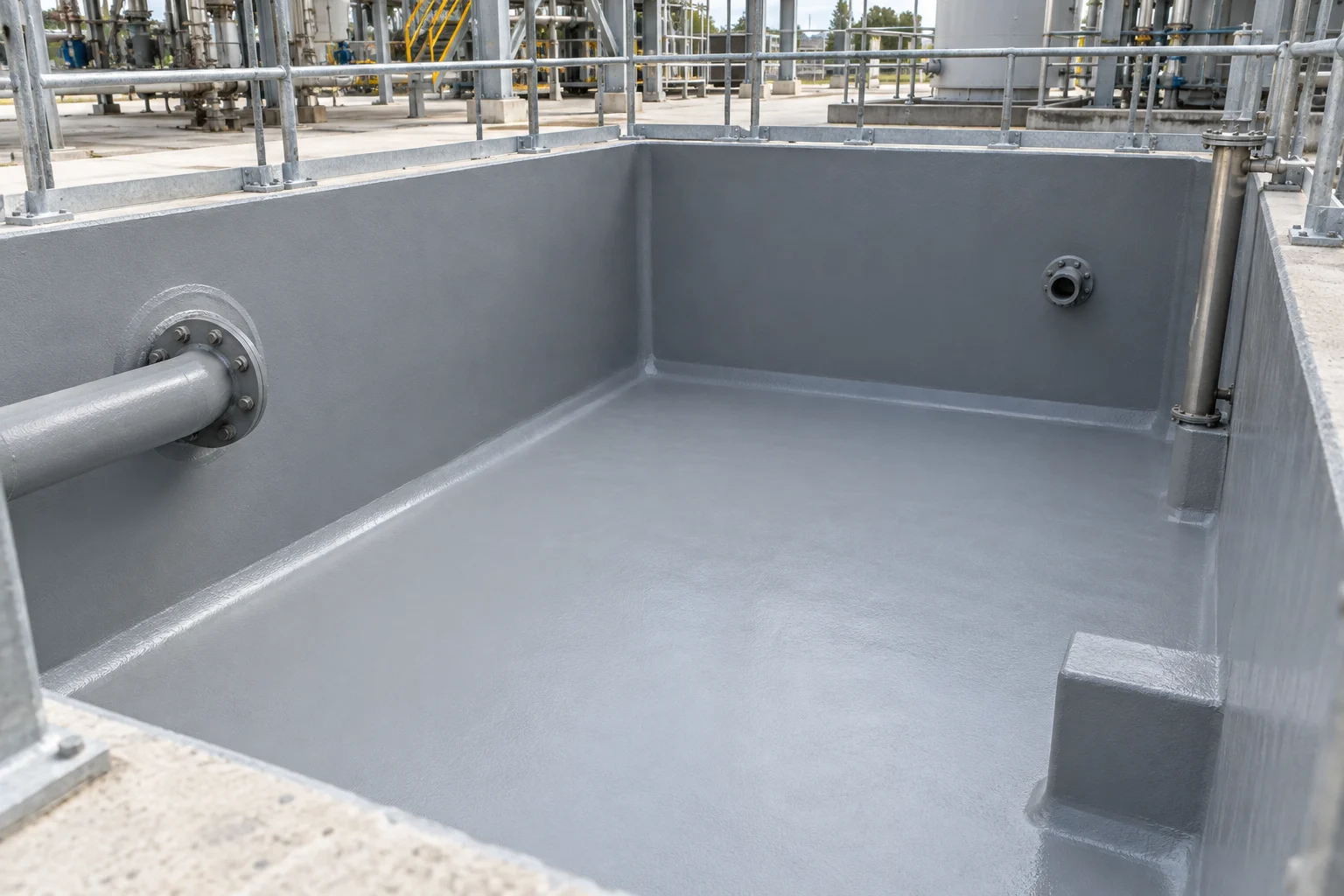
Application Examples
Applications are subject to project-specific approval of the substrate, lining, chemical service and operating temperature.

Process Vessel Linings — Subject to Approval

Industrial Bunds & Containment

Process Sumps
Photographic visuals on this page are AI-generated application illustrations, not completed ALKA projects. Colours are illustrative. The system schematic is conceptual and not to scale; refer to current ALKA technical data and project specifications.